
Accelerate Business Impact From Data, Software And AI
Portworx provides an enterprise-grade, software-defined data management platform that extends the Kubernetes operating model to automate and simplify storage processes. This increases developer productivity, improves resiliency and reduces cost.

Storage abstraction and simplification
Aggregates and pools storage for consumption in a simple, centralized platform.

Automated capacity management
Intelligent, rule-based dynamic growth of persistent volumes and storage pools.

Application performance and data reliability
High availability across nodes, racks, and availability zones, optimized performance with storage-aware class-of-service.
How Portworx Accelerates Business Impact From Data

Increase Developer Productivity
Provide development and AI teams with a simplified, cloud-like experience for data management, independent of underlying infrastructure. Eliminate the silos between VM admins and DevOps teams by understanding KubeVirt—allowing developers to provision storage for VMs as easily as they do for containers using standard Kubernetes APIs.
- Developer self-service for persistent storage, allowing fast, frictionless provisioning.
- Eliminate infrastructure bottlenecks and noisy neighbor issues.
- Accelerate testing and CI/CD pipelines with faster, more reliable incremental builds.
Maximize Application Performance
Quickly provision and easily tune storage for performance and resiliency.
- Provision and attach volumes within milliseconds.
- Tune and accelerate I/O paths for Kubernetes applications and volumes.
- Enable high-availability across multiple data centers.
Automate Storage Management
Efficiently manage storage resources at scale, anywhere, with intelligent, automated operations.
- Dynamically balance, scale, and resize Kubernetes storage with a built-in rules engine.
- Use only the storage you need with thin provisioning.
- Optimize volume placement with granular, intelligent affinity / anti-affinity rules.
Unify Data Management
Remove the complexities of different storage infrastructures of today’s hybrid and multi-cloud environments, reducing costs and the need for deep expertise across multiple clouds.
- Eliminate the unique CSI dependencies for each storage provider in the environment.
- Provide uniform and consistent data management across containers and VM workloads.
- Migrate applications anywhere within minutes across on-premises and cloud infrastructure.
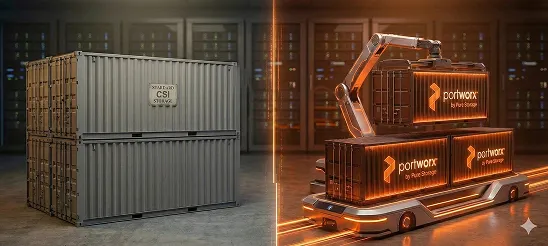
Don't let CSI hold back your Kubernetes
Portworx is the bridge to cloud native storage that begins where CSI ends. Learn how Portworx delivers automation for hybrid and multi-cloud data consistency.
Featured Kubernetes Storage Products

Automate storage operations and maximize application performance with enterprise-grade storage management.

Protect application data with built-for-Kubernetes backup and recovery that is application aware and container granular.

Ensure business continuity with synchronous and asynchronous disaster recovery no matter where your data's located.
Customer Stories
-
NVIDIA
-
BCBS of Alabama
-
HSBC
-
Fiserv

“Development teams don’t need to think about what’s under the covers. Once it’s up and running we need availability…we have zero-down time maintenance, Portworx allows us to shift workloads to different nodes without any impact on our users”
Brian Monroe, Senior Software Engineer, NVIDIA
Read the Case Study
“Portworx made VM migrations 10X faster and It revolutionized our Kubernetes journey”
Victor Williams, Blue Cross Blue Shield of Alabama
Read the Case Study
There's more value in the [Portworx] platform itself. You've got backup, DR, and replication capabilities... We're not tied to a particular flavor or Kubernetes or storage.
-Steve Lewis, Global Head of Engineering - Container Platforms, HSBC
Read the Case Study
The impacts of the business are clearly reliable software deployments,where we're deploying more features…this allows developers to get towards multiple deployments perhaps per month, per week.
- John Durko, Director of IT, Product Architect, Container Services at Fiserv
Read the Case StudyCheck Out Our Kubernetes Storage Resources


Analyst Report
IDC MarketScape Names Pure Storage a Leader in Container Data Management.