
Product Announcements
Everpure Fusion and Portworx: Redefining Enterprise Storage for the Kubernetes Era


Summarize Blog With
Table of Content
Enterprises are rapidly standardizing on Kubernetes to manage both modern containerized applications and traditional virtualized workloads. As the application operating model evolves, storage teams are being asked to deliver the same enterprise-grade governance, performance tiering, and data protection they’ve always provided, but now through Kubernetes-native, self-service workflows. The challenge is that the centralized tools storage teams rely on weren’t originally designed to plug directly into the declarative, on-demand model that platform teams and developers expect. Bridging that gap without compromising the control and reliability storage teams are responsible for is exactly where organizations are looking to accelerate their digital transformation.
As infrastructure fleets grow across multiple arrays and teams, these challenges become more acute. Discovering available resources and enforcing consistent policies across complex environments often requires intensive manual coordination between storage administrators and Kubernetes operators. Organizations need more than just integration; they need a way to make enterprise storage policy consumable inside Kubernetes without sacrificing centralized governance. This is precisely the role of the integration between Everpure FusionTM and Portworx®.
The integration bridges the gap between centralized storage management and Kubernetes-native consumption. By combining the fleet-wide orchestration of Everpure Fusion with the data services of Portworx, organizations can deliver storage-as-code with a self-service model that mirrors the cloud experience.
Key Advantages for the Modern Enterprise
Architecture in Action: Bridging the Control Plane and Data Plane
To understand the power of this integration, one must look at how it harmonizes the disparate layers of the infrastructure stack. The solution operates by bridging the SaaS-based management of Everpure Fusion with the localized, high-performance execution of Portworx in the Kubernetes cluster.
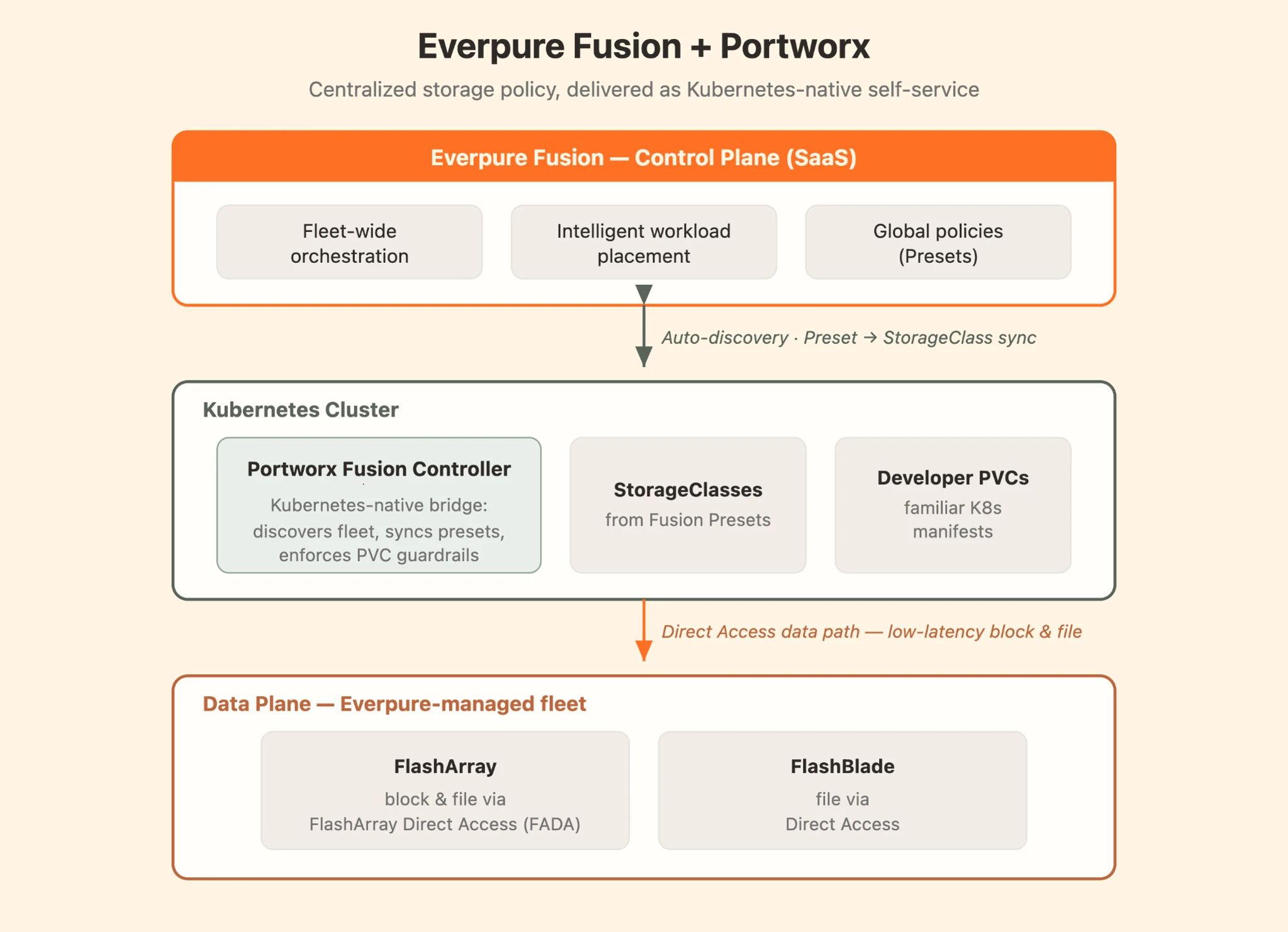
Everpure Fusion (Control Plane): Serving as the brain of the operation, the Everpure Fusion Control Plane provides SaaS-based management for fleet-wide orchestration. It handles intelligent workload placement and global policy definitions, abstracting multiple arrays into a single consumable endpoint.
Portworx Fusion Controller: This component acts as the Kubernetes-native bridge. It is responsible for dynamically discovering the storage fleet managed by Everpure Fusion and synchronizing policies (Presets) into the cluster as StorageClasses, ensuring that the Kubernetes environment is always aware of the storage capabilities available.
Data Plane: The physical movement of data is handled via FlashArray Direct Access (FADA). This ensures seamless, low-latency connectivity for both block and file resources, providing the performance required for the most demanding enterprise applications.
Operational Simplicity through Automated Discovery
One of the primary benefits is the elimination of manual hardware configuration. The integration enables automatic discovery of the Everpure Fusion-managed fleet. Portworx identifies available storage resources across FlashArray and FlashBlade devices without requiring administrators to manually configure each array within the Kubernetes environment. This zero-touch approach ensures that as your infrastructure grows, your Kubernetes environment stays synchronized with the source of truth in the storage fleet.
Automated Token Lifecycle and Seamless Authentication
Security is often the most significant hurdle in automated provisioning. The Portworx Fusion Controller eliminates manual credential management by automating the population and refresh of the px-pure-secret. This mechanism ensures that the Portworx runtime is always authenticated against the Everpure Fusion control plane. By refreshing configuration every 5 minutes and supporting both Kubernetes Secrets and HashiCorp Vault, the integration ensures continuous connectivity without requiring storage administrators to rotate keys manually, significantly reducing the risk of unauthorized access or service interruptions.
Centralized Governance with Policy-to-StorageClass Sync
Everpure Fusion allows infrastructure teams to define storage policies, or “presets,” once at the fleet level. These presets, covering QoS, replication, and snapshot policies, are automatically materialized as standard Kubernetes StorageClasses. This ensures that corporate governance is enforced universally, preventing configuration drift and ensuring that every provisioned volume meets enterprise standards.
Guardrails & Enforcement: Centrally Defined Compliance
Governance is not just about defining policies; it is about enforcing them. Portworx acts as a gatekeeper, validating all incoming PersistentVolumeClaims (PVCs) against the constraints defined in Everpure Fusion Presets before any provisioning occurs. If a request violates size limits or uses incorrect parameters, Portworx rejects the request and surfaces validation errors on the PVC for immediate developer feedback. Furthermore, the system prevents the mixing of Everpure Fusion and non-Fusion StorageClasses within the same environment, ensuring a compliant and standardized infrastructure that adheres to corporate mandates.
Accelerated Developer Self-Service with Workload Consolidation
Developers can now consume enterprise-grade storage using familiar Kubernetes manifests and declarative APIs. When a developer requests a PersistentVolumeClaim (PVC), the Portworx controller coordinates directly with Everpure Fusion to handle intelligent placement and automated provisioning. This “application-first” workflow removes the need for developers to understand underlying hardware silos, allowing them to focus entirely on building and deploying applications faster.
This developer experience is further enhanced by Automated Workload Consolidation. In traditional environments, managing storage for multi-volume applications like StatefulSets can be complex. The integration utilizes a mutating webhook that automatically identifies PVCs belonging to the same workload (Deployment, StatefulSet, KubeVirt VM, or namespace-scoped Pods/Jobs/CronJobs). These volumes are then grouped into a single cohesive Workload object in Everpure Fusion, which is represented by the FusionWorkload Custom Resource (CR) in the Kubernetes cluster. This ensures that the Fusion Placement API views the application as a single unit, providing absolute consistency across storage placement and ensuring that data remains highly available and optimally located for the application’s specific needs.
Unified Support for Mixed VM and Container Workloads
Today’s data centers are rarely exclusive to one technology. Many organizations are migrating VM workloads to KubeVirt-based solutions while simultaneously scaling containerized applications. This integration of Everpure Fusion and Portworx provides a consistent operating model across both. Whether it is supporting hot-plug for virtual disks or dynamic provisioning for StatefulSets, Everpure Fusion and Portworx ensure that all stateful workloads benefit from the same high-performance, policy-driven storage backend.
Availability
Everpure Fusion support for Portworx is available in Early Access today with expected General Availability in Portworx Enterprise 3.7, scheduled for August, 2026.
Conclusion
The challenge of modern platform engineering is no longer just about provisioning capacity; it is about making enterprise-grade storage services natively consumable at the speed of Kubernetes. By connecting centralized Everpure Fusion management with the Kubernetes-native data plane of Portworx, organizations can finally achieve a cloud-like operating model for their most critical stateful applications.
This integration marks a fundamental shift from a Machine Defined Control Plane, where the focus was on manual machine provisioning and lifecycle management, to an Application Defined Control Plane. In this modern era, infrastructure is aware of the application’s requirements, and provisioning is driven by the end-user rather than a central administrator. By abstracting the complexities of the storage hardware while maintaining enterprise-grade governance, Everpure Fusion and Portworx deliver the agility of the public cloud with the reliability of Everpure.
With Portworx Fusion Controller, customers can adopt a delivered set of capabilities that includes automatic fleet discovery, StorageClass creation from Fusion presets, automated placement for FADA-backed volumes, and support for both virtualized and containerized workloads. The result is a simpler, more consistent, and more scalable way to bring enterprise storage into modern Kubernetes environments.
Frequently Asked Questions
What is the Everpure Fusion and Portworx integration?
The integration between Everpure Fusion and Portworx creates a unified data management platform for Kubernetes. It bridges the centralized, SaaS-based control plane of Everpure Fusion with the high-performance, Kubernetes-native data plane of Portworx. This allows enterprises to manage their entire storage fleet, including FlashArray and FlashBlade devices, with automated, policy-driven workflows directly within Kubernetes.
How does this integration simplify Kubernetes storage management?
This solution eliminates the manual toil of configuring individual storage array endpoints. Through the Portworx Fusion Controller, the system automatically discovers Everpure storage resources across the fleet. It then synchronizes predefined Everpure Fusion storage policies (Presets) into Kubernetes as standard StorageClasses, ensuring that storage provisioning is consistent, policy-compliant, and automated without requiring manual intervention from storage administrators.
What are the key benefits of using Everpure Fusion with Portworx?
The integration delivers three primary benefits: Operational Efficiency: Automates fleet discovery and eliminates per-array manual configuration. Consistent Governance: Enforces enterprise-wide storage policies (QoS, replication, snapshots) uniformly across all Kubernetes clusters. Developer Agility: Empowers developers to consume enterprise-grade storage using familiar Kubernetes manifests and declarative APIs, accelerating application deployment while maintaining administrative control.
How does the integration handle both VM and container workloads?
Everpure Fusion and Portworx provide a consistent operating model that unifies management across traditional and modern application architectures. Whether you are running containerized applications or migrating virtual machine (VM) workloads to KubeVirt on Kubernetes, the integration provides the same high-performance block/file storage, disaster recovery, and policy-driven automation, ensuring all stateful workloads benefit from a unified control plane.
How does the integration ensure enterprise-grade storage compliance?
The integration enforces compliance through policy-to-StorageClass synchronization. Everpure Fusion presets—which define QoS, replication, and snapshot policies—are automatically mapped to standard Kubernetes StorageClasses. Portworx acts as a gatekeeper, validating all incoming PersistentVolumeClaims (PVCs) against these defined constraints. If a request violates size limits or other governance policies, the system rejects the request and provides immediate feedback, ensuring all storage provisioning strictly adheres to organizational mandates.
Recommended for you