Knowledge Article
What Is an Internal Developer Platform (IDP)?

Summarize Blog With


Table of Content
An Internal Developer Platform (IDP) is a self-service layer built by platform engineering teams that automates infrastructure configuration, application deployment, and operational workflows. By creating pre-approved “Golden Paths,” an IDP reduces developer cognitive load and eliminates ticket-driven ops bottlenecks.
Is an Internal Developer Platform a Product?
An Internal Developer Platform (IDP) is a self-service layer built and maintained by a platform engineering team that abstracts away infrastructure complexity so application developers can deploy, operate, and manage services without becoming experts in Kubernetes, Terraform, or cloud provider APIs.
The distinction is important: an IDP is not a product you buy, it is an opinionated system your platform team constructs from composable tools and exposes to developers as a coherent experience. Its primary job is to eliminate the ticket queue. A developer who needs a database, a CI/CD pipeline, or a new namespace shouldn’t have to file a request and wait three days. They should be able to provision those resources themselves, within guardrails the platform team has already encoded.
At its best, an IDP compresses the cognitive overhead of modern software delivery into a set of well-defined workflows (often called golden paths) that encode security requirements, capacity policies, observability defaults, and compliance controls automatically.
This table summarizes the IDP benefits vs. traditional, ticket-driven operations:
| Capability / Metric | Traditional Ticket-Driven Ops | Modern Internal Developer Platform (IDP) |
|---|---|---|
| Provisioning Speed | Days to Weeks (Manual Tickets) | Minutes (Self-Service) |
| Developer Autonomy | Low (Blocked by Infrastructure Teams) | High (Pre-Approved Golden Paths) |
| Operational Overhead | High Context-Switching & YAML Wrangling | Automated Workflows & Abstraction |
| Governance & Security | Manual Audits & Ticket Reviews | Automated Policies & Built-In Compliance |
IDP vs. Internal Developer Portal: What is the Difference??
These terms are frequently conflated, but they refer to distinct layers of the platform engineering stack.
A developer portal (such as Backstage) is a UI surface – a catalog of services, APIs, documentation, and templates that gives developers a unified view of the software ecosystem. It surfaces discoverability and provides a launchpad for golden path workflows.
An Internal Developer Platform is the operational substrate beneath the portal. It includes the automation, APIs, provisioners, controllers, and policy engines that actually fulfill developer requests. When a developer clicks “create new service” in Backstage, the IDP is what provisions the namespace, attaches the storage class, wires up secrets management, and registers the CI pipeline.
In practice, most mature platforms have both: Backstage (or a similar portal) as the human interface, and a collection of Kubernetes controllers, GitOps pipelines, and infrastructure APIs as the IDP.
What Are the Architectural Planes of an IDP?
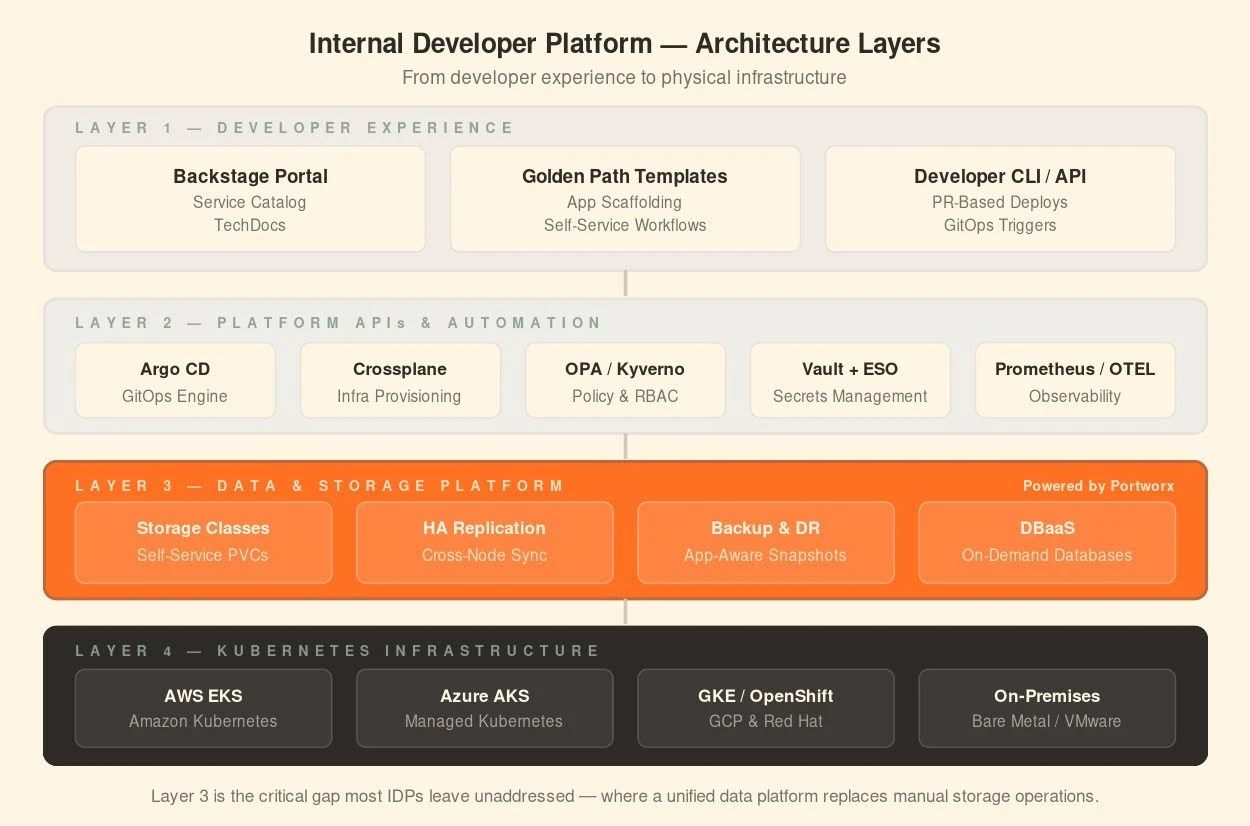
A useful way to describe an Internal Developer Platform is as four architectural planes:
- Developer Experience
- Platform Orchestration
- Runtime & Infrastructure
- Operations & Governance
Developer Experience Plane
The interface developers use to interact with the platform: developer portals, service catalogs, templates, APIs, CLIs, and self-service workflows. Examples include Backstage, Port, and custom portals.
Platform Orchestration Plane
The automation layer that translates developer requests into infrastructure and application changes. This typically includes GitOps, CI/CD, Infrastructure as Code, policy engines, operators, and workflow automation. Examples: Argo CD, Flux, Crossplane, Terraform, Tekton.
Runtime & Infrastructure Plane
The underlying execution environment where applications run. In a Kubernetes-based IDP, this includes Kubernetes clusters, compute, networking, storage, ingress, service mesh, and cloud or on-prem infrastructure.
Operations & Governance Plane
The capabilities that keep the platform reliable, secure, compliant, and observable. This includes monitoring, logging, tracing, security controls, policy enforcement, backup, disaster recovery, cost management, and SRE/Day-2 operations.
What Are the Core Components of a Kubernetes-Based IDP?
Most production IDPs running on Kubernetes share a common set of building blocks:
Developer Portal and Service Catalog
Backstage remains a popular choice for internal developer portals in 2026. It now has more than 3,400 adopters, including Airbnb, LEGO, HCA Healthcare, and Toyota North America, and ranks among the highest-velocity projects in the CNCF (CNCF 2025 Annual Survey). It provides a software catalog, TechDocs integration, and a plugin ecosystem that surfaces the IDP’s capabilities (e.g., golden path templates, scaffolding, and operational dashboards) through a unified UI.
GitOps Engine
GitOps is the deployment model of choice for Kubernetes-based IDPs. Argo CD or Flux CD reconcile cluster state against Git as the source of truth, providing a full audit trail and enabling developers to trigger deployments through pull requests rather than CLI commands or Slack messages.
This model is foundational for IDPs because it encodes the approval and deployment workflow into version-controlled artifacts (YAML manifests, Helm values, or Kustomize overlays) that the platform team can gate with policy.
Infrastructure Provisioning Layer
Crossplane has emerged as the standard approach for provisioning cloud infrastructure, such as RDS instances, S3 buckets, and managed Kafka clusters directly through Kubernetes APIs. A platform team defines composite resource definitions (XRDs) that expose a simplified interface to developers while handling the underlying provider-specific complexity.
Terraform-based approaches remain common, particularly in organizations with large existing Infrastructure as Code (IaC) estates, often surfaced through Atlantis or integrated into GitOps pipelines.
Policy and RBAC
Open Policy Agent (OPA) / Gatekeeper or Kyverno enforce guardrails at admission time. This is how the platform team ensures that every workload that touches the cluster meets baseline requirements: resource limits set, container images from approved registries, required labels present, security contexts enforced.
Secrets Management
Secrets should never live in Git. The standard pattern integrates Vault (or a cloud-provider equivalent) with the External Secrets Operator to sync secrets into Kubernetes namespaces at runtime. Developers declare what secrets their application needs; the platform handles provisioning and rotation.
Observability Stack
A built-in observability stack, typically Prometheus, Grafana, and an OpenTelemetry collector, is provisioned automatically as part of any golden path. Developers get metrics, dashboards, and alerting without having to configure them. The platform team owns the retention policies and alert routing.
Persistent Storage Layer
This is where most IDPs have a gap, and where significant operational complexity lives. More on this below.
What Are Golden Paths in Platform Engineering?
A golden path is an opinionated, pre-built workflow for a specific category of developer need. Rather than giving developers unrestricted access to a Kubernetes cluster and expecting them to figure out the right way to deploy a PostgreSQL database, the platform team builds a golden path that produces a properly configured, HA-enabled, observable, and backed-up database instance through a single template or API call.
Golden paths work because they encode decisions that developers shouldn’t have to make repeatedly. The platform team decides once what a “production-grade database” looks like, including: replication factor, backup schedule, monitoring thresholds, storage class, encryption settings, and more, and bakes that into a template. The developer declares their intent (“I need a PostgreSQL instance for this service”); the golden path handles the implementation.
Well-designed golden paths have these properties:
Self-service by default. Developers don’t wait for human approvals for standard requests. Policy gates happen at admission time, not through ticket queues.
Opinionated but not rigid. Golden paths cover 80% of use cases with no configuration required. Escape hatches exist for the remaining 20%, but they require deliberate action and may trigger a review process.
Observable from the start. Every resource provisioned through a golden path inherits the platform’s observability configuration automatically.
Portable across environments. The same template works in dev, staging, and production. Environment-specific values (replica counts, resource limits, backup retention) are parameterized, not hardcoded.
The Stateful Storage Gap in Most IDPs
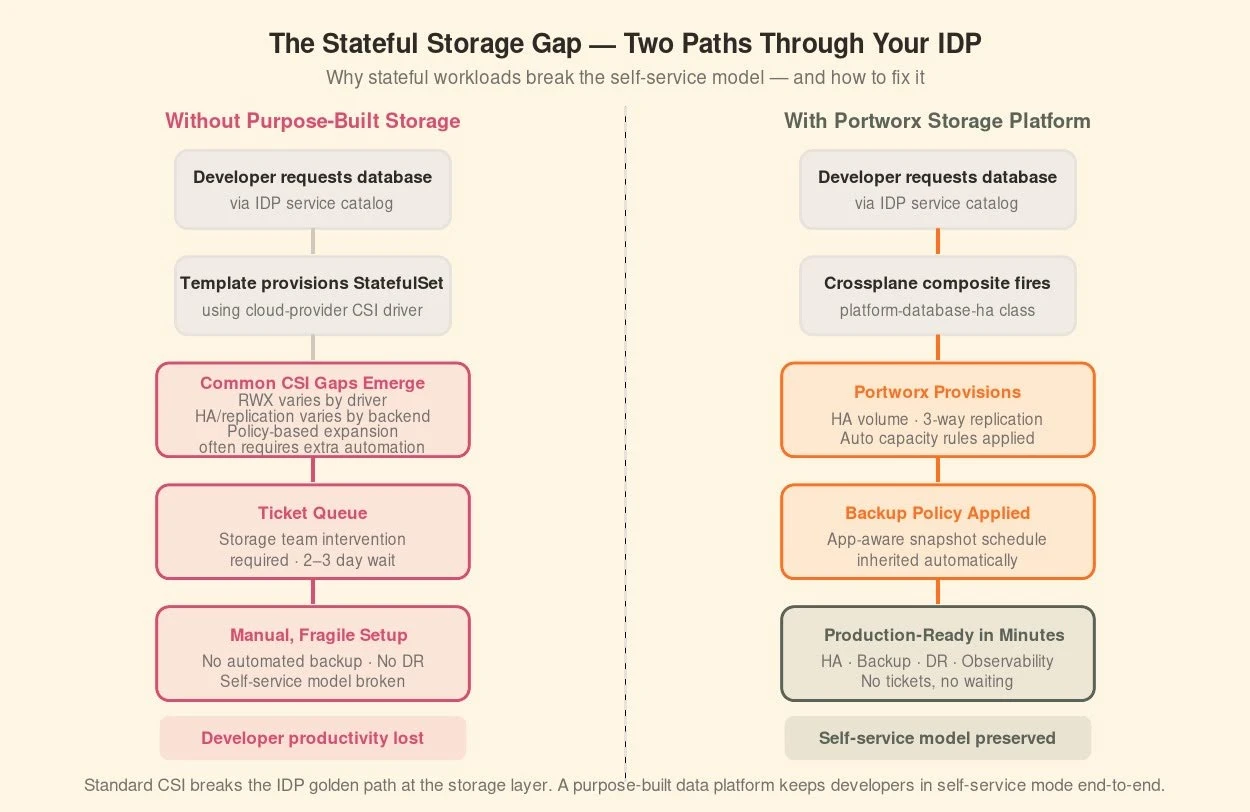
Here is the honest reality of most Kubernetes-based IDPs in production today: stateless workloads have excellent golden paths; stateful workloads don’t.
Platform teams have invested heavily in abstracting deployment, scaling, and networking for stateless services. Spinning up a new API service with CI/CD, ingress, and observability is often a five-minute workflow. But the moment a developer needs persistent state (e.g. a database, a message queue, a distributed cache) the experience degrades. Yet stateful workloads are now mainstream: 72% of organizations run databases on Kubernetes (Data on Kubernetes 2024 Report) so this gap affects the majority of production estates.
The reasons the gap exists are structural.
CSI Driver Fragmentation
The Container Storage Interface (CSI) is the standard Kubernetes mechanism for connecting storage to pods.
Most platform teams rely on cloud-provider CSI drivers such as Amazon EBS CSI, Google Persistent Disk CSI, or Azure Disk CSI, or on vendor-provided CSI integrations. These are effective for many basic RWO volume use cases, but capabilities such as RWX, application-consistent snapshots, cross-cluster replication & DR, and policy-based capacity automation vary significantly by driver, backend, and cloud provider.
Each cloud provider handles these features differently, with different APIs, different limitations, and different operational models. A platform team building for multi-cloud or hybrid environments ends up maintaining a patchwork of storage classes, annotations, and provider-specific workarounds that are difficult to expose as a coherent golden path.
Day 2 Operations Are Manual
Even when initial storage provisioning is self-service, Day 2 operations frequently are not. Capacity expansion, snapshot management, backup verification, and disaster recovery testing often require intervention from a storage or infrastructure team that sits outside the platform team. This creates the exact ticket-queue bottleneck that IDPs are designed to eliminate.
A developer whose service is hitting storage capacity limits shouldn’t need to file a ticket with a storage team. But in most organizations, they do.
StatefulSets Add Orchestration Complexity
Kubernetes StatefulSets provide stable network identities and persistent volume claims for stateful applications, but they require significantly more orchestration knowledge than Deployments. Pod disruption budgets, volume claim templates, ordered rolling updates, and the interaction between StatefulSets and storage class binding modes are all sources of operational complexity that most developers cannot be expected to understand.
The platform team’s job is to abstract this complexity, but doing so requires a storage layer with the right automation primitives. Standard CSI drivers don’t provide them.
Building Storage Into Your IDP Golden Path
A production-ready IDP needs storage to behave as a first-class platform primitive, not an infrastructure afterthought. This means the platform team must treat the storage layer with the same design rigor applied to compute and networking.
Define Storage Classes as Platform Contracts
Storage classes should be treated as named contracts that developers reference by intent, not by implementation detail. Instead of exposing gp2, pd-ssd, or Premium_LRS to developers, define classes with names like platform-database-ha, platform-cache-fast, or platform-analytics-bulk. Each class encodes the right performance tier, replication behavior, and encryption settings for its intended use case.
Developers declare which class they need; the platform determines how to fulfill it.
# Developer-facing PVC — no cloud-provider specifics
apiVersion: v1

kind: PersistentVolumeClaim

metadata:

 name: postgres-data

spec:

 storageClassName: platform-database-ha

 accessModes:

   - ReadWriteOnce

 resources:

   requests:

     storage: 100Gi
Automate Capacity Management
Persistent volumes should grow automatically when approaching capacity thresholds. Manual capacity expansion is a Day 2 operational burden that breaks the self-service model. The storage layer needs rules-based dynamic volume expansion: detecting when a volume approaches a configured threshold and expanding it within policy bounds without requiring human intervention or application downtime.
Integrate Backup Into the Golden Path
Backup should not be an opt-in capability that developers configure separately. Every stateful workload provisioned through a golden path should inherit a backup policy automatically. This means the storage layer needs application-aware backup that understands when a database is in a consistent state for snapshotting, not just filesystem-level snapshots that may capture data mid-transaction.
For PostgreSQL, application-consistent backup means coordinating snapshots with PostgreSQL’s backup process and ensuring the required WAL files are retained for recovery. For distributed databases, it means coordinating snapshots across multiple volumes and replicas so the restored application returns to a consistent state
Build for Multi-Cluster Portability
Modern IDP architectures often span multiple Kubernetes clusters: dedicated clusters per environment, per team, or per region. The storage layer must provide consistent behavior and consistent operational interfaces across all of these clusters, whether they run on the same cloud provider or different ones. Developers and platform operators shouldn’t need to reason about which cloud-provider storage API is in play.
What Are the Storage Architecture Patterns for IDPs?
Database-as-a-Service Within the Platform
Rather than exposing raw PersistentVolumeClaims to developers, mature IDPs provide a Database-as-a-Service (DBaaS) abstraction. Developers request a database instance through the service catalog; the platform provisions the StatefulSet, PVCs, secrets, monitoring, and backup schedule as a unit.
Crossplane composite resources are well-suited to this pattern. The platform team defines a composite resource like PostgreSQLInstance that encapsulates all of the operational complexity:
apiVersion: platform.company.io/v1alpha1

kind: PostgreSQLInstance

metadata:

 name: payments-db

spec:

 version: "16"

 size: medium          # maps to CPU/memory/storage profiles

 ha: true              # triggers replication setup

 backupRetention: 30d

 environment: production
The composite resource controller handles everything else: volume provisioning with the right storage class, StatefulSet configuration, network policy, service account, backup schedule, and monitoring dashboard registration.
Storage Pools and Aggregation
A common limitation of node-local storage approaches is that individual node capacity becomes a ceiling for individual volume sizes. Storage pool aggregation (pooling the available storage across multiple nodes into a logical layer) eliminates this constraint and enables large volumes to be provisioned dynamically without manual node-level configuration.
Portworx Enterprise uses this model, aggregating local or attached storage across the cluster into storage pools that can be allocated on demand. This is what makes self-service provisioning of large volumes viable: the developer requests a 2TB volume and the platform fulfills it from the pool without requiring a human to identify which node has sufficient capacity.
High Availability and Replication
For production stateful workloads, volumes should be replicated synchronously across multiple nodes. If a node fails, the volume should be immediately available on another node without data loss, and without the platform team being paged. This requires a storage layer that handles replication independently of the application.
Standard CSI drivers delegate this responsibility to the underlying storage backend, which may not provide node-level replication semantics within a Kubernetes cluster. A platform-native storage solution handles replication in-cluster, making HA a storage class property rather than an application architecture decision.
How Portworx Addresses the IDP Storage Gap
Portworx Enterprise is designed specifically for the operational model that IDPs require: API-first, automation-friendly, and consistent across cloud providers.
Where standard CSI drivers stop at volume provisioning, Portworx extends Kubernetes storage semantics to cover the full lifecycle of stateful workloads (provisioning, capacity management, replication, snapshot, backup, restore, and migration) through Kubernetes-native APIs that integrate cleanly with GitOps workflows and Crossplane composites.
For platform teams building golden paths, this means storage behaves as a programmable platform primitive rather than infrastructure that requires manual intervention. Automated capacity expansion, application-consistent snapshots, and multi-cluster replication are all available as declarative configuration, not operational runbooks.
For developer self-service, Portworx removes the dependencies that break the self-service model. A developer provisioning a database through a golden path gets HA-replicated storage, automated backups, and capacity management without knowing or caring what’s underneath. The platform team defines the policy once; Portworx enforces it automatically.
For multi-cloud and hybrid environments, Portworx provides a consistent storage and data-management control plane across supported Kubernetes distributions, managed cloud services, OpenShift, and on-premises clusters. This helps platform teams define policy once and expose storage through reusable golden paths.
HSBC captures it directly
“We needed a (storage) platform that could retain data integrity. That’s what brought us to Portworx. It’s a valuable platform where we can build at scale.” – Steve Lewis, Global Head of Engineering – Container Platforms.
And Fiserv confirms:
“The impacts of the business are clearly reliable software deployments, where we’re deploying more features…this allows developers to get towards multiple deployments perhaps per month, per week.” – John Durko, Director of IT, Product Architect, Container Services
Day 2 Operations: Where IDPs Succeed or Fail
The first effort of platform engineering is building things that work at day zero. The remaining and ongoing effort is making them work reliably over months and years. Day 2 operations are where IDPs can struggle to deliver on their promise.
Capacity Planning and Expansion
Volumes fill up. The right operational model proactively monitors volume utilization and expands capacity before an application hits its limit. This requires integration between the storage layer and the platform’s alerting infrastructure, plus automation that can expand a volume without application downtime.
Backup Verification
Backups that aren’t tested aren’t backups. A mature IDP includes scheduled restore verification – automatically restoring from recent backups to an isolated environment and verifying application-level consistency. This closes the gap between “we have backups” and “our backups actually work.”
Disaster Recovery Testing
DR plans that require manual runbooks fail under pressure. The platform should support automated DR testing: simulating a cluster failure, failing over to the replica cluster, verifying application availability, and failing back, all driven by automation rather than a step-by-step guide.
Security and RBAC for Storage
Storage is a data security boundary. The platform needs to enforce encryption at rest for all persistent volumes, control which namespaces can provision which storage classes, and provide audit logging for data access and operations. These controls should be enforced by the platform, not delegated to individual application teams.
Getting Started: Building Storage Into Your IDP
If you’re building or maturing a Kubernetes-based IDP and storage is still a source of manual operations, ticket-based requests, or inconsistent behavior across environments, the right time to address it is before your golden paths are fully established.
Adding a programmable, automation-native storage layer early means your golden paths can include storage as a first-class capability from the start — rather than retrofitting it into existing templates and abstractions later.
Portworx Enterprise provides the storage primitives that IDPs need: self-service provisioning, automated capacity management, application-aware backup, and consistent multi-cloud behavior — all through Kubernetes-native APIs that integrate with your existing GitOps and Crossplane workflows.
Hands-on Labs
Learn how Portworx can help you protect, manage and unify Kubernetes storage with live instructors.

Frequently Asked Questions
What is the difference between an IDP and an Internal Developer Portal?
An Internal Developer Portal (like Backstage) is the UI surface that gives developers a catalog of services, templates, and documentation. An Internal Developer Platform is the operational substrate (the automation, APIs, and controllers) that fulfills the requests developers make through the portal. Both are part of a mature platform engineering stack, but they serve different roles.
Why do stateful workloads break IDP golden paths?
Standard CSI drivers provide basic volume provisioning but don’t cover the full operational lifecycle required for production stateful workloads: automated capacity expansion, application-consistent snapshots, cross-node replication, and multi-cluster disaster recovery. Platform teams end up with manual processes for Day 2 operations that break the self-service model that IDPs are designed to provide.
What Kubernetes storage classes should I define for an IDP?
Define storage classes that reflect developer intent, not infrastructure implementation. Good examples: a high-availability class for production databases (with replication and automated backups), a fast class for caching workloads (optimized for IOPS), a bulk class for analytics data (optimized for throughput and capacity cost). Keep cloud-provider specifics hidden behind these abstractions so the same template works across environments.
How do you handle backup and disaster recovery in a Kubernetes IDP?
Backup should be built into every golden path for stateful workloads, not an opt-in configuration. Application-aware snapshots, coordinated at the application level, not just the filesystem level, provide consistency guarantees that bare volume snapshots cannot. Disaster recovery should be testable through automation, with defined RTO and RPO objectives encoded into storage class policies.
What is ReadWriteMany (RWX) and when does it matter for IDPs?
ReadWriteMany (RWX) is a Kubernetes access mode that allows a single persistent volume to be mounted by multiple pods simultaneously in read-write mode. It’s required for shared data workloads (e.g. content management systems, shared ML datasets, multi-instance applications that share file state). Many standard cloud block storage CSI drivers do not support RWX natively; RWX support depends on the driver, backend, and whether the storage layer provides distributed file-system semantics. Platform teams need a storage solution that provides distributed filesystem semantics to enable this access mode.
How does platform engineering differ from traditional DevOps?
DevOps focused on breaking down silos between development and operations teams, typically through shared tooling and culture. Platform engineering applies product thinking to internal tooling: a dedicated team builds and operates infrastructure capabilities as a product, with internal developers as customers. The goal is to create golden paths that let developers ship independently, rather than requiring cross-team coordination for every infrastructure need. The model is now mainstream: Gartner expects 80% of large software engineering organizations to have platform teams by 2026, up from 45% in 2022.