Open Source
Your VMs Moved to Kubernetes. Did Your Backup and DR Strategy Move With Them?


Summarize Blog With
Table of Content
The types of applications run on Kubernetes are evolving yet again. What initially began as an open-source project for stateless workloads has evolved to host not only stateful workloads, but increasingly critical and data-intensive applications. According to the Voice of Kubernetes Experts 2026 report, 58% of organizations run stateful applications in their Kubernetes environments. Once these environments started hosting not only persistent data but critical persistent data, organizations had to make a shift in their data strategy. They needed to solve for availability and resilience.
Quickly, what these organizations realized is that the legacy backup solutions of old wouldn’t work for Kubernetes, which was much more dynamic and ephemeral by design than VMs. They needed a backup solution that was Kubernetes aware, meaning their solution needed to understand all the components of a Kubernetes application to produce consistent and reliable backups. Further, as more critical applications moved to Kubernetes, they needed to ensure data protection moved beyond just backup and restore to include resilience capabilities like synchronous disaster recovery.
The Landscape Shifts Again
Virtual machines are now reshaping what runs on Kubernetes. Under rising cost pressure and a push to standardize infrastructure, 42% of organizations are choosing to run their VMs on Kubernetes, and 74% plan to modernize or migrate VMs to Kubernetes1.
VMs are arriving on Kubernetes through KubeVirt-based platforms at a pace few platform teams planned for, and they bring a set of expectations about backup and recovery that were formed over years of running VMware. Backup and recovery tools must be able to keep pace with these changes, otherwise they risk exposing the data to potential unrecoverable loss or inconsistencies that lead to extended downtime.
In the same survey, 56% of respondents rated backup, disaster recovery, and high availability as the most critical capabilities for their Kubernetes platforms. Teams know this matters. The challenge is that the tooling and the operating models in this new paradigm are still catching up.
What it Takes to Recover a VM on KubeVirt
On a hypervisor, a VM is largely self-contained: back up its disks and configuration file, and you can bring it back. On KubeVirt, a VM is a set of Kubernetes objects, including VirtualMachines, DataVolumes, secrets, and ConfigMaps. If any of these are not backed up or not associated with the VM it came from, it won’t properly restore. Capturing the objects and the data as one recoverable unit is a must.
But VM administrators expect much more than just a baseline backup and restore. They are used to fast incremental backups, application-consistent snapshots, file-level recovery, and single-VM restores measured in minutes. With KubeVirt, some of these are mature, some are maturing, and some depend on the tooling you choose.
Another gap is disaster recovery. VMware teams also relied on replication and orchestration tools like VMware Site Recovery Manager that provided mature featuresets like non-disruptive testing and single-click failovers. Most KubeVirt environments don’t yet have an equivalent that is broadly adopted.
According to the Gartner® report “Modernize Kubernetes Backup for KubeVirt and AI Workloads”, “This tooling deficiency is an absolute showstopper for enterprise adoption. Organizations are migrating mission-critical applications into KubeVirt under a false assumption of safety, leaving them exposed to catastrophic regional outages2.”
A complete KubeVirt data resilience strategy needs to consider both point-in-time backups and tested DR that can bring VMs up in another site or region.
Three Paths Enterprises are Taking
1. Community-driven tooling
Open-source projects are often the first stop. They are accessible, free to start, and well understood by Kubernetes administrators. For dev/test clusters or early proofs of concept, they can be a reasonable choice. The trade-off shows up in production, when the organization becomes responsible for building, integrating, and supporting everything the project does not do.
Limited to best-effort support and CLI interfaces, community-driven tools force internal teams to build and maintain custom backup and DR platforms. For modern stateful applications in production, this DIY approach introduces unacceptable risk.
— Gartner2
2. Platform-native tools
Most Kubernetes distributions and managed Kubernetes services now include some form of built-in backup. These options are convenient and quick to enable, and they are a sensible baseline. They are also, by design, scoped to the platform they ship with.
…while these embedded tools simplify basic backup for platform-specific environments, they often deliver limited feature sets, tightly locking recovery operations to the underlying distribution and constraining multicloud data mobility.
— Gartner2
For KubeVirt, that lock-in has a cost. One reason many organizations are moving VMs to Kubernetes is to gain freedom of choice across on-premises and cloud infrastructure. A recovery strategy tied to a single distribution undercuts that goal.
3. Third-party, enterprise-grade platforms
The third path is a purpose-built data protection platform that understands both Kubernetes and VMs. Third-party tooling has not yet reached full parity with the toolsets VMware administrators have used for years. The ecosystem is still maturing, and buyers should test every claim against their own workloads. But this is where the gap is closing fastest, because these vendors are focused specifically on making VMs on Kubernetes recoverable at enterprise scale.
How Portworx by Everpure approaches KubeVirt protection
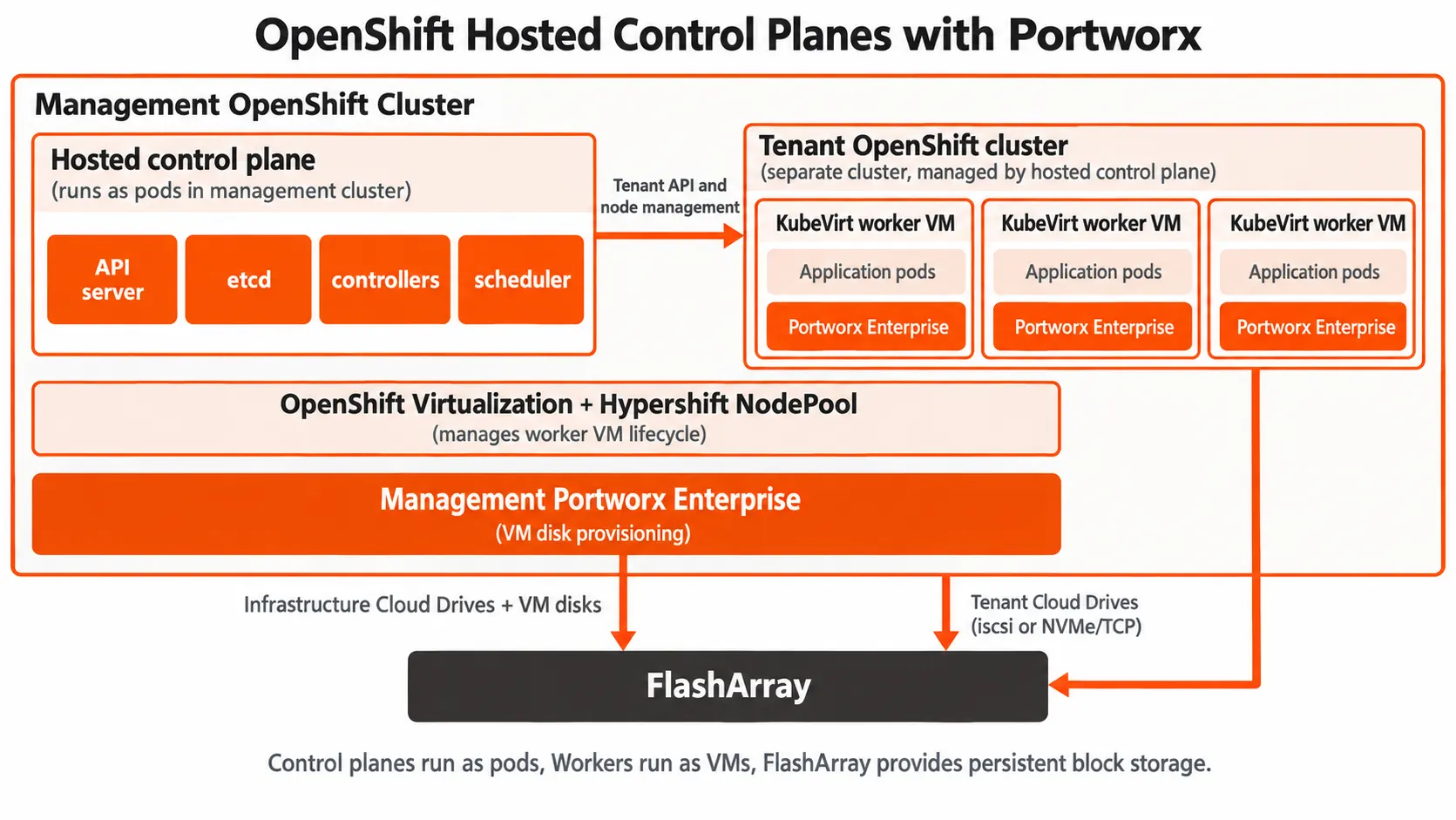
Portworx by Everpure was built for stateful applications on Kubernetes and protects VMs on KubeVirt-based platforms such as Red Hat OpenShift Virtualization and SUSE Virtualization. Customers are already running over a hundred thousand VM volumes on Kubernetes with Portworx.
Portworx Backup captures the full VM, objects and disk data together, so restores boot quickly and consistently. Other feature support includes granular file-level restore to recover individual files without restoring the whole volume.
For disaster recovery, Portworx provides synchronous replication for KubeVirt VMs with zero RPO, asynchronous DR covers replication across regions, and DR protection can be defined at the individual VM level. Policy-based protection covers new VMs automatically as each migration wave lands, and immutable backup targets keep recovery copies out of an attacker’s reach.
Want to try it out for yourself? Run VMs alongside containers on OpenShift Virtualization with Portworx in your own lab environment, ready in about 15 minutes. Try the on-demand hands-on lab.
- Portworx by Everpure, The Voice of Kubernetes Report 2026. ↩︎
- Gartner, Modernize Kubernetes Backup for KubeVirt and AI Workloads, Fintan Quinn, 24 September 2026. Gartner is a trademark of Gartner, Inc. and/or its affiliates. ↩︎
Gartner does not endorse any company, vendor, product or service depicted in its publications, and does not advise technology users to select only those vendors with the highest ratings or other designation. Gartner publications consist of the opinions of Gartner’s business and technology insights organization and should not be construed as statements of fact. Gartner disclaims all warranties, expressed or implied, with respect to this publication, including any warranties of merchantability or fitness for a particular purpose.
Recommended for you