
Technical Insights
Financial Services Move Critical Workloads to Kubernetes


Summarize Blog With
Table of Content
Data lies at the heart of the financial services industry. From processing trillions of dollars in transactions to running asset management analysis and real-time fraud detection, the stakes are high. For many financial institutions, Kubernetes has become the platform of choice for these mission-critical workloads-delivering the speed, reliability, and flexibility needed to serve customers and meet regulatory requirements.
That flexibility matters now more than ever. Rising VMware costs, political and regulatory uncertainty, and mounting pressure on IT teams to do more with less are forcing financial institutions to rethink their infrastructure from the ground up.
The Voice of Kubernetes Report 2026, based on a survey of more than 500 infrastructure professionals with direct VMware VM management experience at enterprise companies invested in Kubernetes, reveals how financial institutions are responding, and what it means for the future of their platforms.
Why is Kubernetes the Platform of Choice for Financial Institutions?
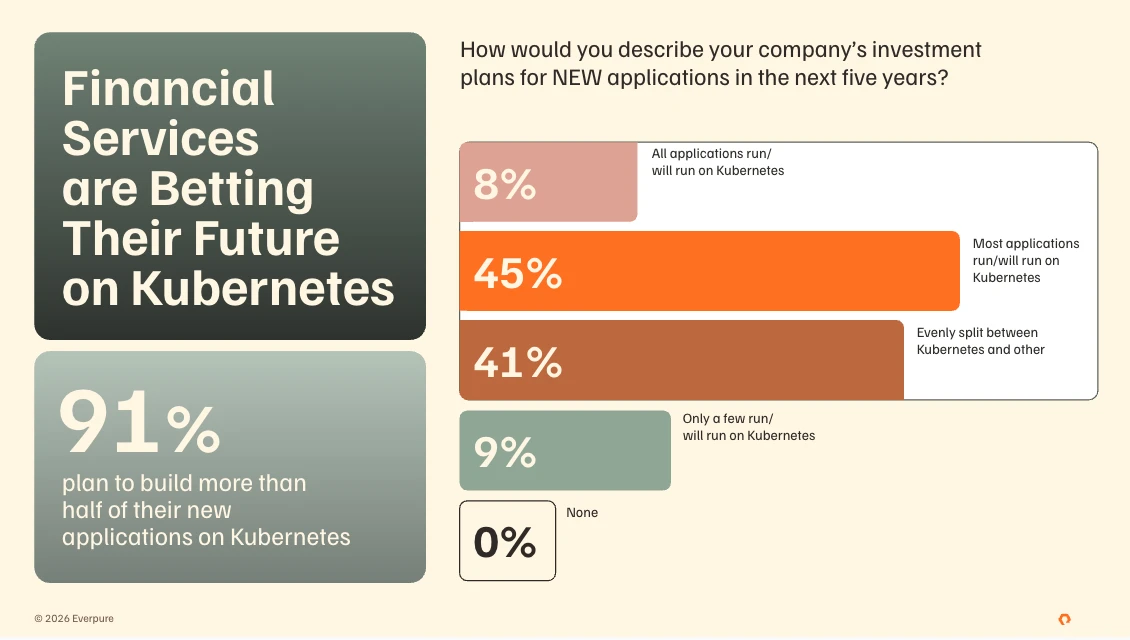
Financial services companies are well past the experimentation phase for Kubernetes. They’re betting on it. 72% of financial services institutions said at least half of their current application footprint was built on Kubernetes, compared to 64% of the average across industries. A whopping 91% plan to build at least half of their new applications on Kubernetes, compared to 84% across industries.
For these organizations that have invested in Kubernetes, the commitment is clear. This becomes more evident when looking at the types of workloads being run in these environments. Although Kubernetes was first developed as an orchestrator for stateless, ephemeral workloads, financial services are now using it for their most critical, data-intensive applications, like AI/ML (43%) and data analytics pipelines (64%).
AI adoption in particular is becoming a critical mandate. AI provides developers with a way to not only build and deploy applications faster than ever, but it also helps financial institutions to quickly identify security vulnerabilities. Any institutions that choose not to modernize their stack are exposing themselves to unprecedented risk.
How are VMware Cost Pressures Accelerating the Path to Modernization?
It’s no industry secret that enterprises of all sizes are facing cost pressures in the form of VMware license cost renewals. 97% of organizations surveyed stated that their VMware cost increased with their most recent license renewal. This cost pressure is triggering a huge migration away from VMware.
69% are looking to proactively reduce their overall VMware usage. IT teams cannot sit idly by as costs increase and as the industry shifts models for building and deploying new applications.
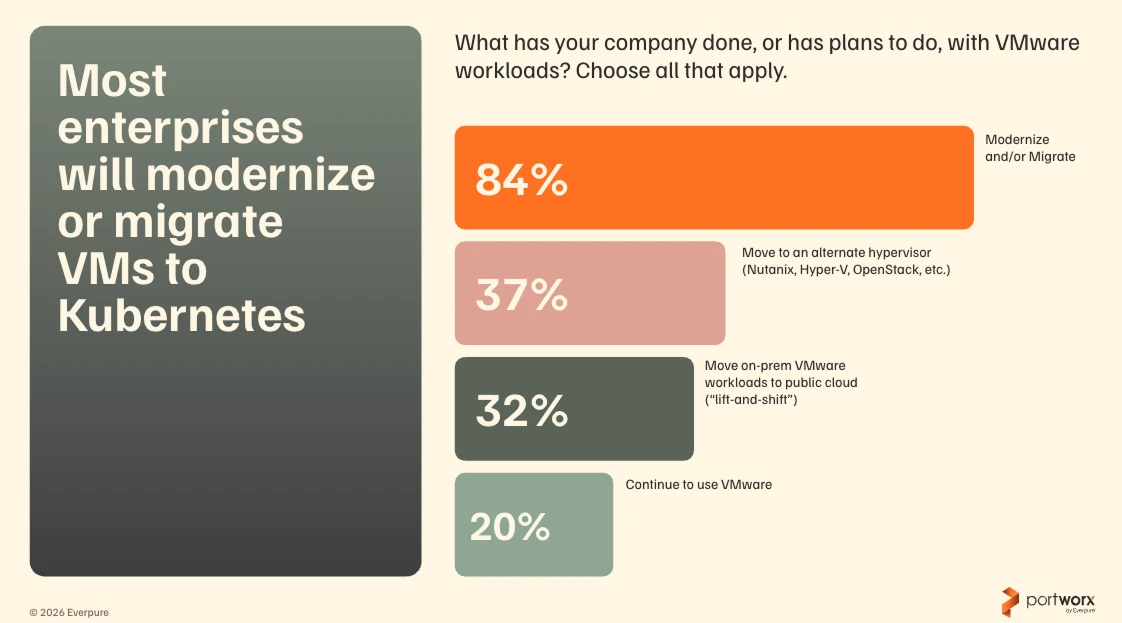
Enterprises face many options when it comes to moving workloads off VMware, and financial institutions are leading the modernization charge. 84% chose to modernize some of their VMs, either by rearchitecting them to run as containers or by migrating VM management to Kubernetes via technologies like KubeVirt. This was 10% higher than the average of 74% across industries, reinforcing that FSI organizations are more committed to Kubernetes as a long-term platform than most.
Migrating VM management to Kubernetes helps bridge the gap between legacy and modern workloads, allowing financial services firms to modernize at their own pace. Further, it also allows for a unified control plane between VMs and containers, eliminating the need to manage two separate IT systems.
Why Data Management Can’t be an Afterthought
Platform teams for financial institutions must also consider performance and resilience, both of which are critical when considering the types of critical applications being run in both legacy and modern environments. Downtime, data loss, and poor performance are not options.
Enterprises must maintain robust data management capabilities as they move away from VMware. The top three capabilities for financial institutions reflect this need to keep their data secure and stable:
- 51% require backup and disaster recovery
- 50% must maintain fault tolerance
- 49% need live migration and high availability
These are table stakes for any platform trusted to run the financial systems that millions of people and businesses depend on every day.
Driven by the pressures of VMware cost increases and the need to modernize infrastructure, FSI organizations are adopting Kubernetes at higher rates than other industries, and they’re doing so with greater commitment and a sharper eye toward what it takes to run mission-critical workloads reliably.
As VMs and containers coexist on Kubernetes platforms, organizations need data management solutions that can keep up – protecting data, ensuring resilience, and maintaining performance across every workload. The financial institutions that get this right will build the infrastructure foundation to compete in an increasingly data-driven, AI-powered industry.
Want to learn more? Download the Voice of Kubernetes 2026 Report today to see the complete story and join our webinar: Why Data Platforms Are Breaking in Banking and Beyond to learn more:
- May 19th at 10 AM PT: Click here to register (Americas)
- May 20th at 10 AM CET: Click here to register (EMEA)
Frequently Asked Questions (FAQs)
Q: Q: Why are Financial Institutions adopting Kubernetes?
Kubernetes is the platform of choice because it delivers the speed, reliability, and flexibility required for mission-critical, data-intensive workloads. This includes applications like data analytics pipelines (64%) and AI/ML (43%).
Q: Q: How are rising VMware costs affecting Financial Services organizations?
VMware license cost increases are triggering a large-scale migration away from the platform. 97% of organizations surveyed reported that their VMware cost increased with their most recent renewal, leading 69% to proactively reduce their overall VMware usage.
Q: Q: What modernization strategies are Financial Institutions using to move away from VMware?
Financial institutions are leading the modernization charge by rearchitecting VMs to run as containers or by migrating VM management to Kubernetes using technologies like KubeVirt. 84% of FSI organizations chose this approach, which is 10% higher than the average across industries.
Q: Q: What critical data management capabilities are essential for financial institutions migrating workloads?
Platform teams require robust data management to ensure performance and resilience for critical applications. The top three required capabilities are backup and disaster recovery (51%), fault tolerance (50%), and live migration and high availability (49%).
Q: Q: What is the Kubernetes adoption level of Financial Services Institutions compared to other industries?
FSI organizations show greater commitment to Kubernetes. 72% of FSI reported at least half of their current application footprint is on Kubernetes (compared to 64% average), and 91% plan to build at least half of new applications on it (compared to 84% average).
Recommended for you