Architect’s Corner
Data Protection On Kubernetes Is An Application Problem, Not A Volume Problem


Summarize Blog With
Table of Content
Any application modernization strategy on Kubernetes needs data protection built around the whole application, not the disk alone. Volume snapshots copy block storage while missing database consistency, Kubernetes objects, and configuration. This article shows why stateful workloads need application-consistent backup, topology-aware replication, and zero-RPO disaster recovery, and where volume-level protection leaves gaps.
Stateful workloads now run on Kubernetes at production scale. The Voice of Kubernetes Experts 2024 report, a Portworx-commissioned survey of more than 500 practitioners run by Dimensional Research, found 97% of organizations are running data-intensive workloads on cloud-native platforms.
The workloads themselves are demanding. The survey put databases at 72%, analytics at 67%, and AI/ML pipelines at 54%, the exact profiles that punish crash-consistent recovery.
The protection model most teams inherit came from a different era. Volume snapshots protect disks, and a stateful application is far more than a disk. A backup strategy tied to the storage array copies blocks and leaves the application behind.
What a volume snapshot captures
In Kubernetes, a volume snapshot is a point-in-time copy of a block device, taken inside the storage layer orchestrated by the Container Storage Interface (CSI). CSI snapshots can provide a fast, space-efficient point-in-time recovery option before a migration or upgrade, but the actual speed, capacity overhead, and restore behavior depend on the underlying storage platform. The limit lives in one word: crash-consistent. A snapshot taken without coordinating with the database captures the disk as if power was cut, and pending writes may not be properly captured in the backup. PostgreSQL, MySQL, Kafka, and AI inference pipelines hold in-memory transactions and replication journals at the moment of the copy. Recovery from a crash-consistent state sometimes succeeds, but sometimes leaves silent corruption that surfaces days later.
Application consistency closes the gap by quiescing the workload before the copy, so in-flight writes flush to disk and the data represents a coherent state. Database operators run pre-snapshot and post-snapshot hooks, or the platform triggers write-ahead-log archiving before the snapshot fires.
What volume-level protection misses
Restore only the volume, and you get data with no application around it. A production workload spans far more than its persistent volumes. Kubernetes objects define how the application runs, including Deployments, StatefulSets, Services, ConfigMaps, Secrets, and RBAC policies. The key-value store holds the relationships between them. Volume snapshots protect none of this layer.
Multi-volume applications carry a sharper risk. Split data, write-ahead log, and indexes across separate volumes, and independent per-PVC snapshots record different write orders. Restore each one, and the system boots broken because the volumes come from different points in time. Kubernetes v1.32 moved volume group snapshots to beta to address this, though driver support stays uneven.
Application-aware protection treats the application as the unit of recovery. Portworx captures app-consistent, container-granular backups that cover persistent volumes, Kubernetes objects, and configuration in a single recovery point.
| Protection approach | What it captures | What it leaves out |
| Volume snapshot, crash-consistent | Block-level disk state at a single moment | In-memory transactions, Kubernetes objects, configuration, and cross-volume write ordering |
| Application-consistent backup | Quiesced persistent volumes plus Kubernetes objects, ConfigMaps, and Secrets | Data written since the last recovery point, and state living outside the cluster such as external managed databases or object stores |
What application-aware protection includes
Three capabilities separate application data management from disk snapshots.
Application-consistent backup: captures the persistent volume, Kubernetes resource definitions, ConfigMaps, and Secrets into a single coherent recovery point, with quiescing hooks so that databases restore cleanly.
Topology-aware replication: places and moves data replicas with knowledge of nodes, zones, and clusters, so a replica never lands in the same failure domain as its primary.
Zero-RPO disaster recovery: synchronously replicates every write to a second site, so a failover loses no data.
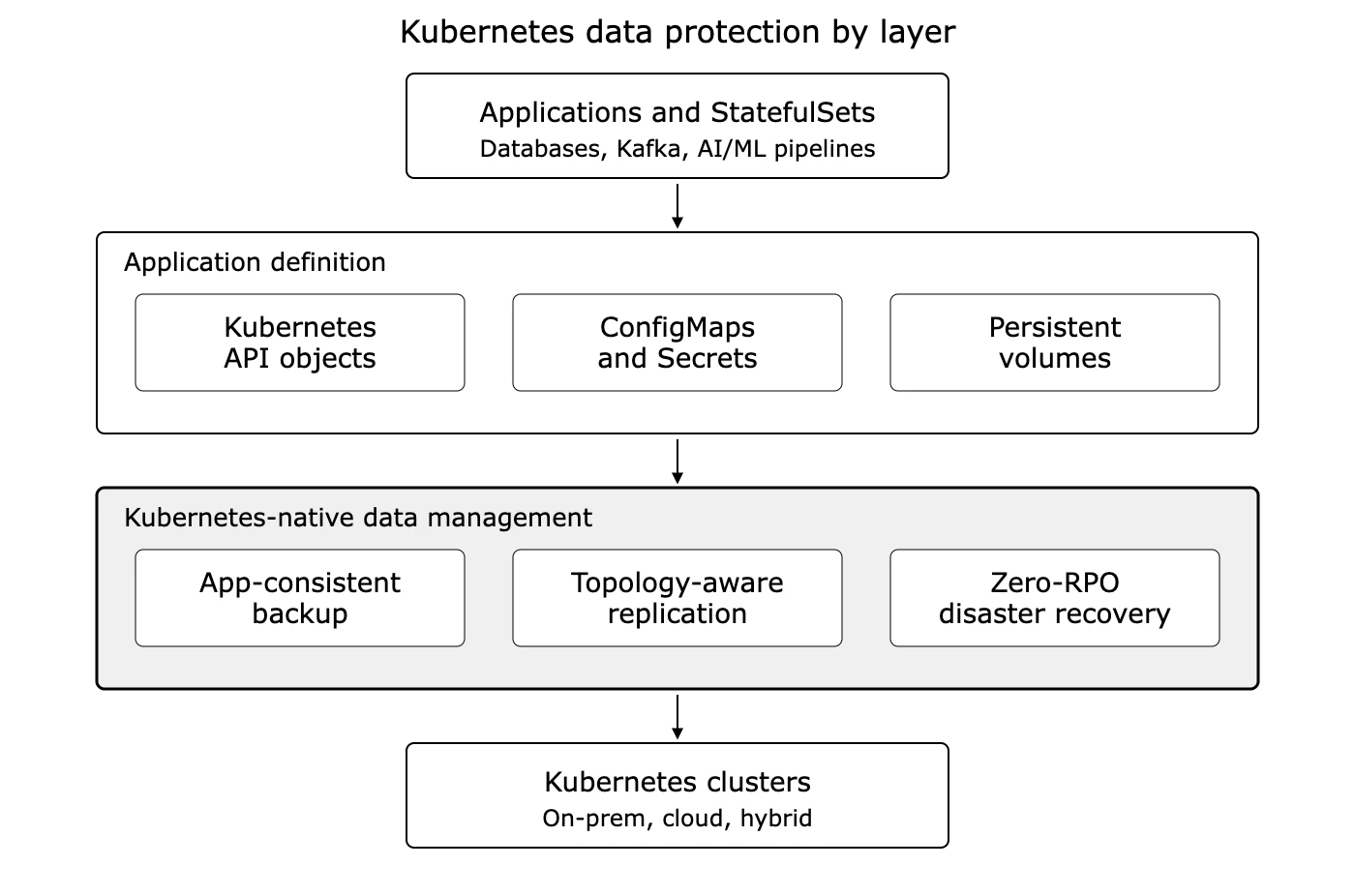
Workloads sit at different tiers, and the protection level follows the tier.
| Workload tier | Recommended protection | Rationale |
| Tier 0, mission-critical databases | Synchronous, zero-RPO replication across a metro region | No data loss on failover, though 10ms latency and a nearby second site are required |
| Tier 1, business-critical apps | Asynchronous replication with an RPO of minutes | Balances performance against cost, with a small, bounded data-loss window |
| Tier 2, general workloads | Scheduled application-consistent backup to object storage | Lower cost and off-cluster durability, with recovery in minutes to hours rather than seconds |
Day 2 is where modernization lives or dies
Migration ends, but operations continue long after go-live. The open question is who carries the storage load and how. When every storage request becomes a ticket to the infrastructure team, modernization rebuilds the bottleneck the project set out to remove.
Self-service closes the loop when developers request a storage class, and the platform handles provisioning, replication, and protection behind the cluster API. Application owners get recovery points without filing a ticket.
Testing carries the other half of the work. A recovery drill restores a production workload to a fresh cluster, verifies correctness, and times the result, which confirms the backup procedure’s success before an incident demands it. Portworx pairs app-aware backup with zero-RPO synchronous DR at the software layer, independent of the storage hardware. Synchronous, zero-RPO replication needs low latency between sites, under 10 milliseconds round trip, which confines the pattern to a metro region. Asynchronous DR reaches farther with an RPO measured in minutes.
Where this leaves platform teams
Volume-level protection earned its place when an application lived on a single disk. Kubernetes broke the application into volumes, objects, and control-plane relationships spread across nodes and clusters. Protection has to follow the application into the same shape. For platform teams standing up mission-critical databases and AI pipelines, the backup and disaster recovery layer decides whether an outage ends in a runbook or a rebuild.
Frequently asked questions
Is a volume snapshot the same as a backup?
No. A snapshot is a point-in-time copy of a block device within the storage layer, suitable for fast local rollback. A backup is a portable copy stored off-cluster for disaster recovery and retention. A snapshot alone does not survive loss of the source storage or a region-wide failure.
What is the difference between crash-consistent and application-consistent backup?
A crash-consistent copy captures the disk as if power were cut, with in-memory database writes possibly unflushed. An application-consistent copy quiesces the workload first so pending writes reach disk. The difference decides clean recovery for PostgreSQL, MySQL, Kafka, and similar systems.
Why do Kubernetes objects need protection when the data is safe?
Restore a volume with no Deployment, StatefulSet, ConfigMap, Secret, or RBAC policy around it, and the application does not run. The key-value store holds the relationships between these objects. A complete backup captures both persistent data and Kubernetes objects.
What does zero-RPO disaster recovery require?
Synchronous replication of every write to a second site, which needs low network latency. The constraint confines synchronous DR to a metro region. Asynchronous DR covers longer distances with an RPO measured in minutes.
Do I need a commercial platform, or is Velero enough?
Velero backs up Kubernetes API objects and persistent volume data and can work as a data protection safety net. The gaps show up under load. It’s schedule-driven, so your RPO is only as tight as your backup interval – minutes to hours of potential data loss, not near-zero. Application consistency isn’t automatic: you script and maintain pre- and post-backup hooks for every database, and a missed hook yields a crash-consistent copy that may not restore cleanly. Multi-volume workloads compound this, and Velero has no synchronous replication, so true zero-RPO failover is out of reach. For near-zero RPO and coordinated, application-consistent recovery, teams add database operators or a data platform such as Portworx. Match the tool to the RPO and RTO the workload demands.
Recommended for you