Open Source
This Month in KubeVirt: April 2026


Summarize Blog With
Table of Content
Welcome to our monthly roundup highlighting project news, community writings, and resources devoted to the KubeVirt project!
This series is intended to be an open-source resource for developers, platform engineers, storage experts, and anyone interested in learning more about the ins-and-outs of Day 1 and Day 2 operations of virtual machines in containers with KubeVirt.
After the landmark v1.8 release and KubeCon EU in March, April was a quieter post-conference month focused on stabilization, community follow-through, and grassroots learning content. In this issue we cover the v1.8.2 patch release, the start of the v1.9 development cycle, a thoughtful set of community tutorials on migration and getting-started, and notable industry adoption news.
Project News
20-Apr: KubeVirt v1.8.2 Released by The KubeVirt Community
The first stabilization release on top of v1.8 landed on April 20. v1.8.2 follows v1.8.1, focused almost entirely on bug fixes and a CVE remediation:
- CVE-2026-33186 remediated by bumping grpc to 1.79.3
- virt-api truncation fix for deep subresources (vnc/screenshot, sev/*, evacuate/cancel) when constructing SubjectAccessReviews, thereby addressing authorization checks against incorrect subresource names
- virt-handler now detects when domain-notify.sock is deleted and automatically restarts the notify server
- Fix for VirtualMachineBackup printer columns (Type, CheckpointName) so they display correctly in kubectl output
- Fix for migration not reporting Succeeded when doing compute migration after a decentralized live migration
- Fix for the Live NAD Ref Update feature so that a VM with no interfaces/networks can start when the LiveNADRefUpdate feature gate is enabled
Release artifacts are available on the kubevirt/kubevirt releases page and pre-built containers are published on Quay.
Ongoing: v1.9 Development Cycle Begins
With v1.8.2 out the door, the SIG Release team proposed the v1.9 schedule on the kubevirt-dev mailing list during April. Authors of new Virt Enhancement Proposals (VEPs) are being prompted to find assigned reviewers, with VEP planning happening at the start of the cycle. If you have a feature idea, this is the time to engage, so see the kubevirt/enhancements repo for the VEP template and process.
Community Meetings and Discussions
Ongoing: KubeVirt Community Weekly Meetings
The KubeVirt community continues to meet weekly on Wednesdays, with SIG Performance & Scale meetings on Thursdays and SIG Storage bi-weekly meetings on Mondays. Recordings of all sessions are available on the KubeVirt YouTube channel. Check the KubeVirt Community Calendar for upcoming sessions.
1-Apr: KubeVirt Community Meeting Recording
The April 1 community meeting (the first after KubeCon EU) recapped v1.8 takeaways, walked through outstanding v1.8.x bug fixes, and discussed the v1.9 enhancement freeze timeline. Recording on YouTube.
Ongoing: Introducing kubevirt-ai-helpers
A new community-led effort to ship Claude Code plugins for KubeVirt development was discussed on the kubevirt-dev mailing list in April, aimed at speeding up local development workflows for contributors. Early days, but worth watching if you contribute to the project.
Community Tutorials, Demos, and Best Practices
3-Apr: KubeVirt 1.8: The VMware Alternative Is Here, by Krun_Dev
KubeVirt 1.8 represents a major architectural shift that positions the project as a viable, open-source alternative to VMware, especially for organizations looking to escape costly licensing fees by consolidating their virtual machines and container workloads onto a single Kubernetes control plane. The release introduces a Hypervisor Abstraction Layer (HAL) that decouples KubeVirt from KVM to support alternative backends like Firecracker, alongside critical performance enhancements for AI and high-performance computing, such as Intel TDX for confidential computing and PCIe NUMA topology awareness to minimize GPU latency. Additionally, with practical operational upgrades like zero-downtime live network updates, incremental backups via Changed Block Tracking (CBT), and proven scalability up to 8,000 VMs, KubeVirt 1.8 successfully closes the technical gap for Kubernetes-first enterprises seeking to modernize legacy virtualized infrastructure.
7-Apr: Escaping VMware Cost Increases — A Technical Demo Showing How to Migrate Your VMs to Kubernetes, by LyveWyre
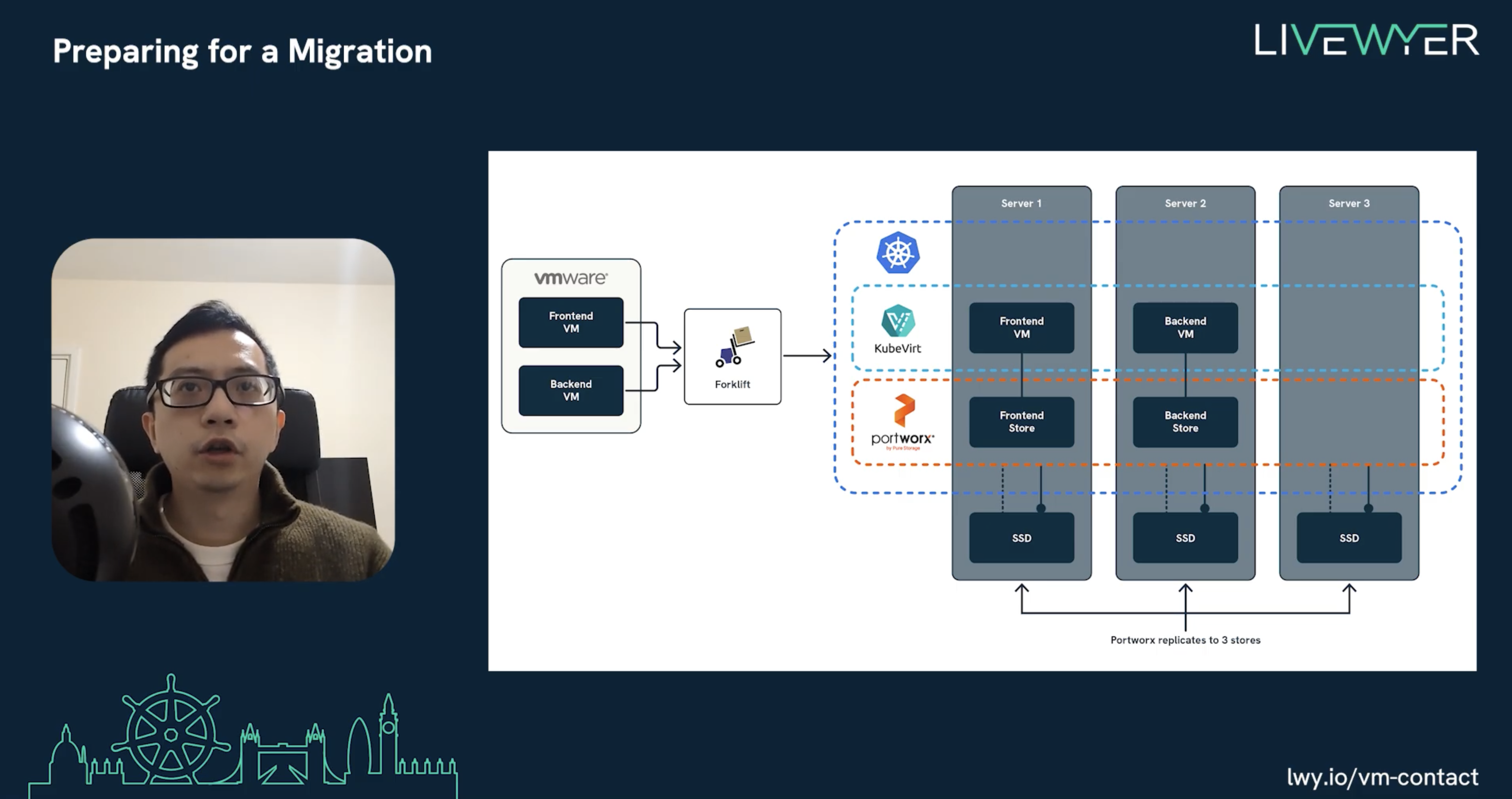
A hands-on technical demo walking through a phased migration approach from VMware to a KVM-on-Kubernetes stack with KubeVirt. The article lays out a pragmatic single-application-first plan, then shows how Forklift (the open-source VM migration toolchain) copies disk data while the VM is still running, takes incremental snapshots with change block tracking, and performs a final delta copy at cutover. virt-v2v handles the image conversion to make the disk KVM-compatible, after which KubeVirt spins the VM back up inside the cluster. A clear walkthrough for teams evaluating a VMware exit on open-source infrastructure.
8-Apr: AI Workloads Are Breaking Kubernetes, Here’s How KubeVirt Fixes It, by the Linux Foundation
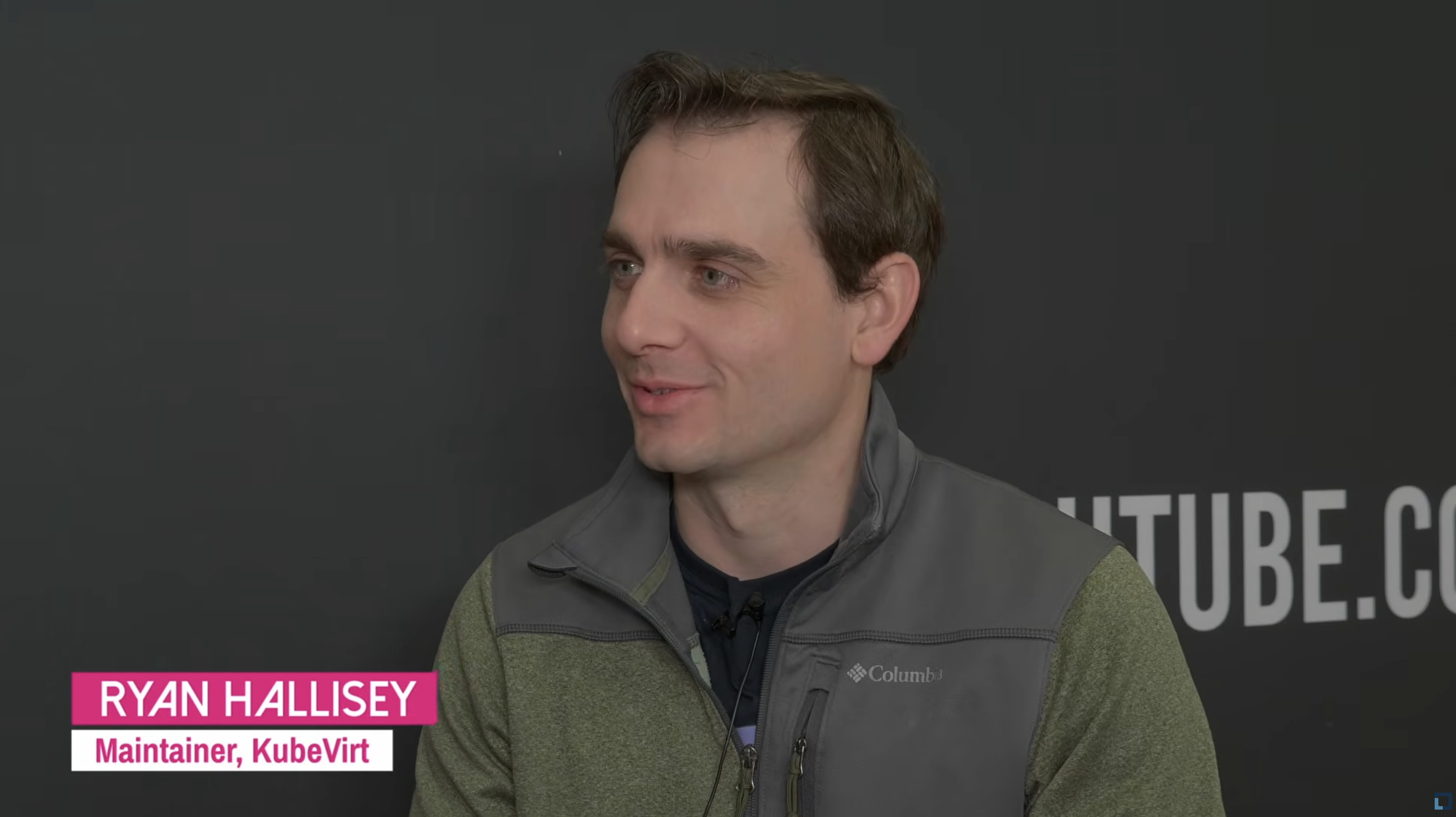
Kubernetes excels at orchestrating containers, but AI and machine learning workloads demand GPU resources that traditional device plugins can’t dynamically allocate. Enterprises running virtualized GPU clouds face rigid allocation models that kill velocity and waste resources.Ryan Hallisey, Maintainer, KubeVirt, explains how dynamic resource allocation (DRA) transforms GPU management in Kubernetes. He discusses NVIDIA’s donation of its DRA driver to the open source community, KubeVirt’s path to CNCF graduation, and how virtualization enables multi-tenant GPU clouds at scale.
30-Apr: Built an MCP Server So Claude Can Run My KubeVirt Cluster, by Andre Rocha
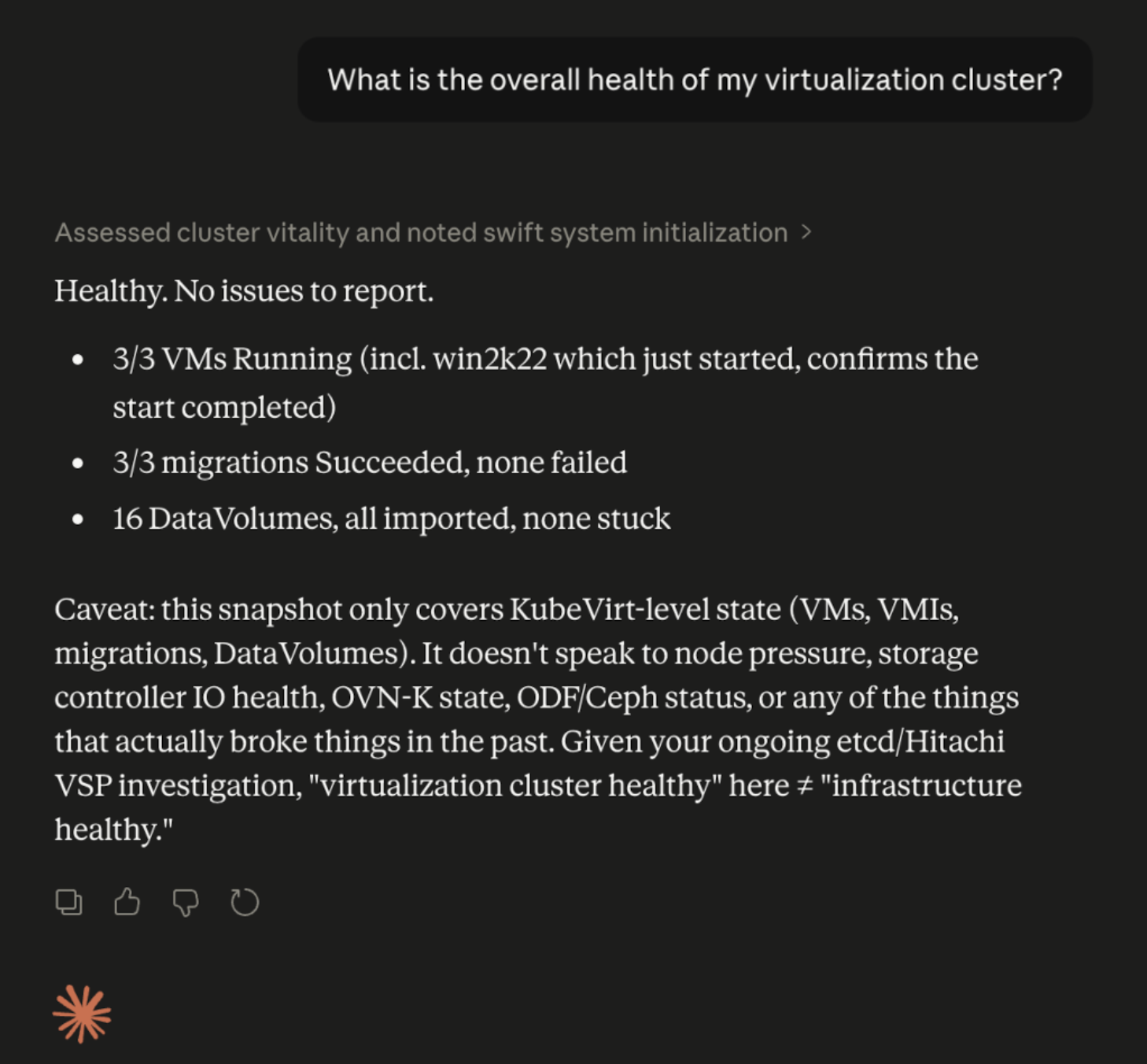
In this article, author Andre Rocha introduces kubevirt-mcp, an open-source Model Context Protocol (MCP) server built in Python that connects Anthropic’s Claude Desktop to a KubeVirt/OpenShift Virtualization cluster. Designed to eliminate the repetitive copy-pasting of voluminous YAML data during virtual machine troubleshooting, the tool splits capabilities into two clear tiers: read-only tools (Tier 1) for fetching live diagnostics, health checks, and recent cluster events, and mutating lifecycle commands (Tier 2) for starting, stopping, or live-migrating VMs across nodes.
Upcoming KubeVirt Events and Talks
Ongoing: KubeVirt Community Calendar
18-19 Jun: KubeCon + CloudNativeCon India 2026, Mumbai, India
9-12 Nov: KubeCon + CloudNativeCon North America 2026, Salt Lake City, Utah
Call for Contributors
Do you love working with KubeVirt? Have tutorials or best practices to share? Get in touch with us!
We’d love to hear about your work and promote it. Send us a short abstract of your topic. Be sure to be clear about your intended audience. Who is this interesting for? Why? What will they get out of it?
Contact us at contributors@kubevirt.blog to get started!
Please note that we do not accept contributions that are promotional or commercial in nature (this roundup is focused on open-source) or AI-generated content.
Archive
Recommended for you