

Revolutionizing Edge Deployments: Portworx and Red Hat

Edge computing is rapidly transforming the enterprise landscape, with growing momentum towards a Kubernetes-based solution. In fact, Gartner predicts that by 2026, 50% of enterprises will initiate Proofs of Concept (PoCs) to transition from their existing VMware deployments to distributed hybrid infrastructure (DHI), underscoring the pivotal role of the Edge for modern workloads. Kubernetes is central to this evolution, enabling the seamless consolidation of containerized and virtualized workloads on a unified infrastructure, particularly at the Edge, where innovative use cases like 5G and AI are emerging alongside established applications in retail, industrial, healthcare, and defense.
Red Hat has introduced the Two-Node with Arbiter (TNA) deployment model for OpenShift, specifically designed to address the unique demands of these specialized Edge environments. We are excited to build on our strategic collaboration between Portworx and Red Hat, which has led to a co-engineered solution combining Portworx Enterprise storage with Red Hat OpenShift Container Platform in a TNA deployment model. This collaboration empowers our mutual customers to deploy containerized and virtualized workloads on a single, robust technology stack across multi-cloud, on-premise, and Edge environments leveraging commodity HW.
The Primary Goal of the Portworx and Red Hat Partnership
The core objective of the partnership between Portworx and Red Hat, particularly concerning the Two-Node Arbiter deployment model, is to collaboratively engineer a solution that empowers our joint customers to run containerized and virtualized workloads on a unified technology stack, and migrate away from a legacy hypervisor based solution, one that has proven costly and inefficient.
This solution, which combines Portworx Enterprise with Red Hat OpenShift in a TNA deployment model, offers flexible deployment options across multi-cloud, on-premise, and Edge environments.
Solution
Portworx Enterprise provides container-native data management platform for virtualized or containerized applications running on Red Hat OpenShift.
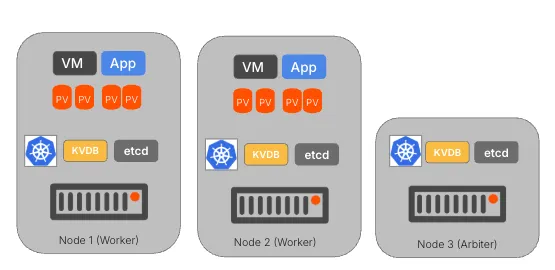
When you step back and look at this configuration, this is essentially a 3-node Portworx cluster, with the restriction that no volume replica be placed on the Arbiter Node (i.e., it serves as a Storageless node and is used for storing Portworx metadata). Red Hat OpenShift ensures no VM or Container workload gets placed on the Arbiter node as well.
This solution has been validated in a lab environment leveraging commodity off the shelf servers, with a small Arbiter node that had limited system resources.
Unlocking Significant Business Value and Cost Savings
This co-engineered solution delivers substantial business value, driving significant cost reductions and enhanced operational efficiency:
- Consolidated Infrastructure: By eliminating the need for separate infrastructures for containerized and virtualized workloads, organizations can realize substantial savings in hardware and maintenance costs.
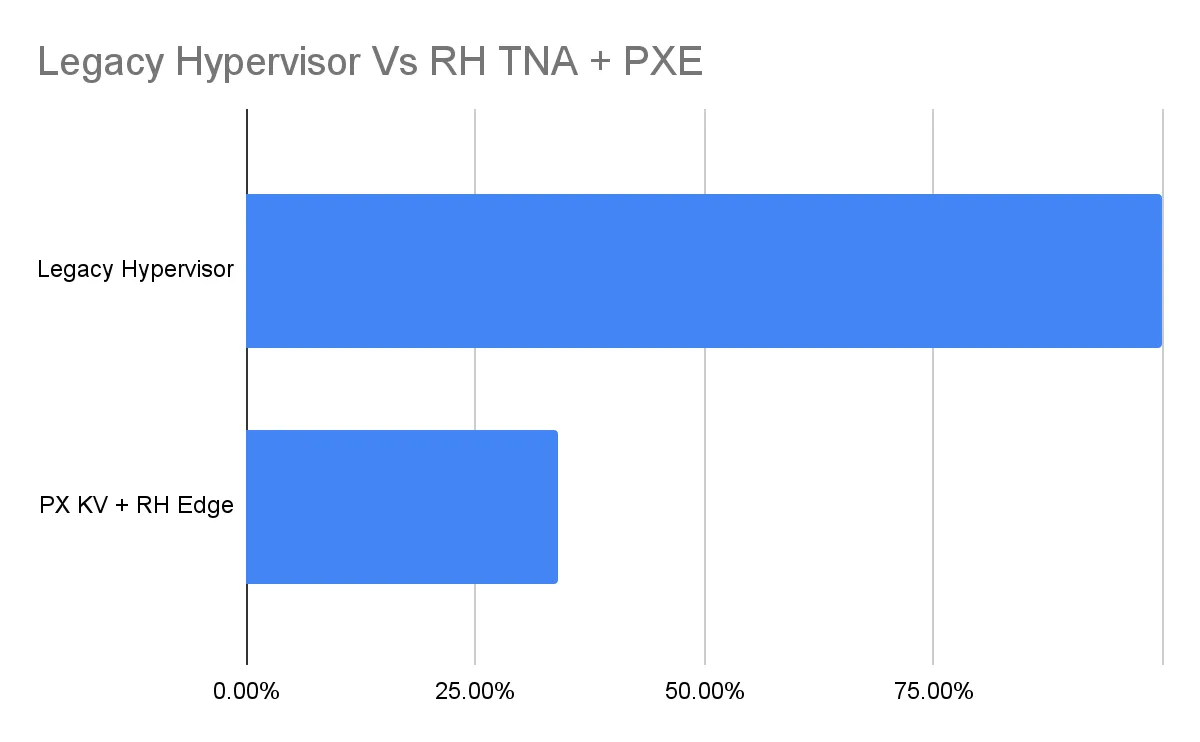
- Reduced Licensing Costs: Customers can anticipate a remarkable reduction in licensing costs, potentially by up to 65%, when deploying their Edge environments on Red Hat Edge with Portworx Enterprise (KV). This estimate is based on a 2-node cluster with a witness/arbiter, assuming 32 cores per node and a VCF list price of $350 USD per core.
- Streamlined Operations: The unification of containerized and virtualized environments obviates the need for separate technical teams, leading to further reductions in operational expenditures.
- Cost-Effective, Commodity Hardware: The solution is optimized to run efficiently on readily available, off-the-shelf hardware, thereby minimizing initial capital investments.
- High Availability and Resilience: Despite its cost-effectiveness, the solution ensures robust high availability and resilience, safeguarding against single hardware failures and facilitating rapid data recovery.
- Simplified Management: Red Hat ACM provides a centralized, single pane of glass for monitoring, administering, and troubleshooting hundreds of Edge clusters remotely, significantly enhancing manageability and reducing administrative overhead.
Critical Features for Edge Deployments
Edge deployments demand specific capabilities, and our co-engineered solution is meticulously designed to address these critical requirements:
- Protection Against Single Failures (Unplanned): The solution incorporates robust data replication, ensuring that applications continue to operate and service requests even in the face of unplanned hardware failures (e.g., CPU, Motherboard, Disk, NIC, DIMM).
- Host Upgrades and Planned Maintenance: With Live Migration, mission-critical applications can run without interruption during planned maintenance events (e.g., hardware servicing, software/firmware upgrades, application patches) by seamlessly migrating to a surviving worker node.
- Cost-Effective, Commodity Hardware: The solution is engineered to perform consistently on affordable, off-the-shelf hardware, even during periods of failure or maintenance. Provides flexibility to choose alternatives to traditional edge-deployed vSAN clusters running VMware vSphere.
- Observability and Manageability: Red Hat ACM empowers administrators to remotely monitor, administer, and troubleshoot numerous small clusters from a unified interface, simplifying lifecycle management operations.
- Supportability: The solution is designed for straightforward maintenance, allowing third-party field technicians with minimal training to perform basic break-fix operations. Additionally, telemetry sent to Pure 1 facilitates remote troubleshooting.
Example of estimated savings in license costs
For the purpose of this exercise, we are assuming the servers deployed at Edge have 32 cores per node. Moreover, we are using the often quoted list price for a legacy hypervisor ($350 USD per core). If the deployment uses more cores, then the pricing for the legacy hypervisor based solution will go up proportionally.
Comparing list prices for a 2-Node cluster (with witness/arbiter), customers could expect to reduce their licensing cost by almost 65% when they chose to run their edge deployments on Red Hat with PX Enterprise (KV).
Conclusion
The synergistic combination of Red Hat TNA and Portworx presents customers with an optimized and highly cost-effective alternative for deploying virtualized workloads within Kubernetes environments. This solution not only delivers the same high levels of availability, resilience, and performance as traditional legacy hypervisors but does so at a significantly reduced licensing and operational cost. We are enthusiastic about the transformative potential this partnership brings to the Edge, enabling businesses to innovate, scale, and thrive with unwavering confidence.
Share
Subscribe for Updates
About Us
Portworx is the leader in cloud native storage for containers.
Thanks for subscribing!

Anshuman Ratnani
Principal Product Manager
Chapter 8: Day 2 Operations: Lifecycle Management and Observability