

What 500+ Infrastructure Leaders Say About the Future of Kubernetes
Enterprise infrastructure is under pressure. Virtualization costs are climbing following Broadcom’s acquisition of VMware. AI and machine learning workloads are scaling rapidly. Tightening data sovereignty and regulatory requirements are forcing decisions for where data should live.
In response, many organizations are rethinking their infrastructure.
The Voice of Kubernetes Report 2026, based on a survey of more than 500 enterprise infrastructure professionals, shows this shift. What it shows is a platform that has grown past its origins. Today, it is becoming the default platform for modern enterprise infrastructure for stateful applications, AI pipelines, and even virtual machines.
Kubernetes Is Becoming the Default for New Applications
Kubernetes adoption has been steadily growing for years, but the data now shows something more significant: a long-term strategic shift. Today, 28% of organizations say most or all of their current applications run on Kubernetes.
But when enterprises look ahead, the picture changes dramatically. Within the next five years, 84% expect to build at least half of their new applications on Kubernetes. This signals a clear transition toward container-first development models.
Enterprises are Running Data-Intensive Workloads on Kubernetes
Kubernetes was originally designed to manage ephemeral, stateless workloads, but enterprise usage has evolved far beyond that. Organizations are now running a broad spectrum of workloads on Kubernetes.
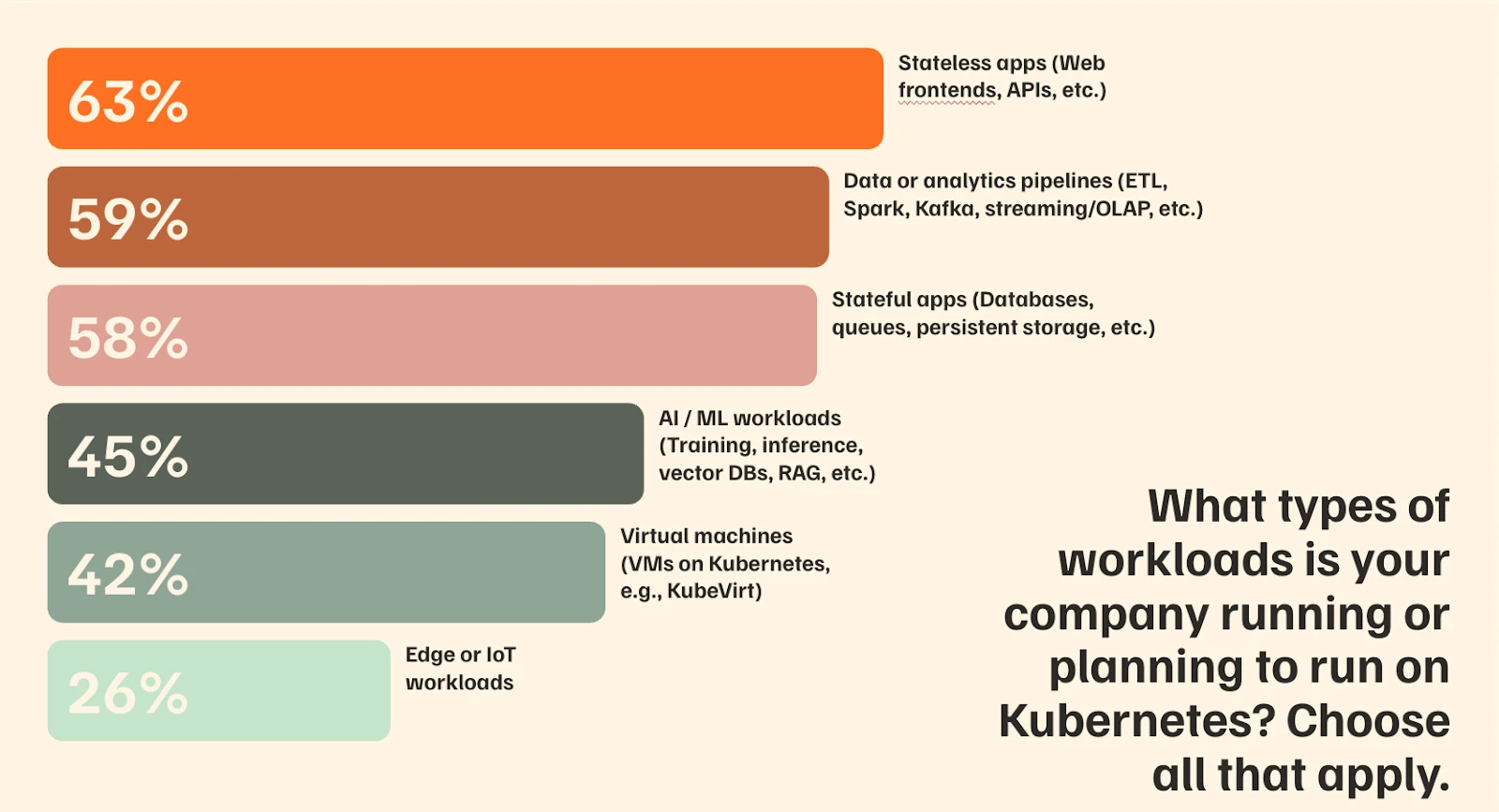
The near-parity between stateless (63%) and stateful (58%) applications is particularly telling. It reflects growing confidence in Kubernetes as a platform for business-critical systems.
AI is accelerating this shift even further. Modern AI pipelines—from model training to inference—are built from highly distributed components that need elastic scaling, intelligent scheduling, and tight integration with CI/CD and data pipelines.
As a result, many organizations are standardizing on Kubernetes as the operational backbone for AI infrastructure, enabling them to manage GPUs, scale model workloads, and integrate data services within a unified platform.
Data Location Is Now a Strategic Infrastructure Decision
Another major trend emerging from this year’s report is the rising importance of data sovereignty. For global organizations, infrastructure decisions are no longer driven solely by performance or cost. Increasingly, they are shaped by where data is allowed to live.
In fact, every respondent reported that regulatory, geopolitical, or customer data sovereignty requirements influence their data strategy.
Organizations are responding in different ways:
- 64% are moving data to in-region hyperscaler data centers
- 41% are shifting data to local cloud providers
- 40% are repatriating data back on-premises
But moving data geographically is only part of the challenge. Enterprises must also ensure that data placement policies, protection strategies, and performance guarantees remain consistent across environments. Without that consistency, the operational complexity of hybrid and multi-cloud deployments can erode the agility Kubernetes promises.
VMware Cost Pressures Are Accelerating the Kubernetes Shift
The most immediate catalyst for infrastructure change is economic. Following Broadcom’s acquisition of VMware, 97% of organizations reported higher licensing costs when renewing their contracts. For many infrastructure teams, this has forced an uncomfortable but necessary question: Is the traditional virtualization model still sustainable?
The answer, for most organizations, appears to be no.
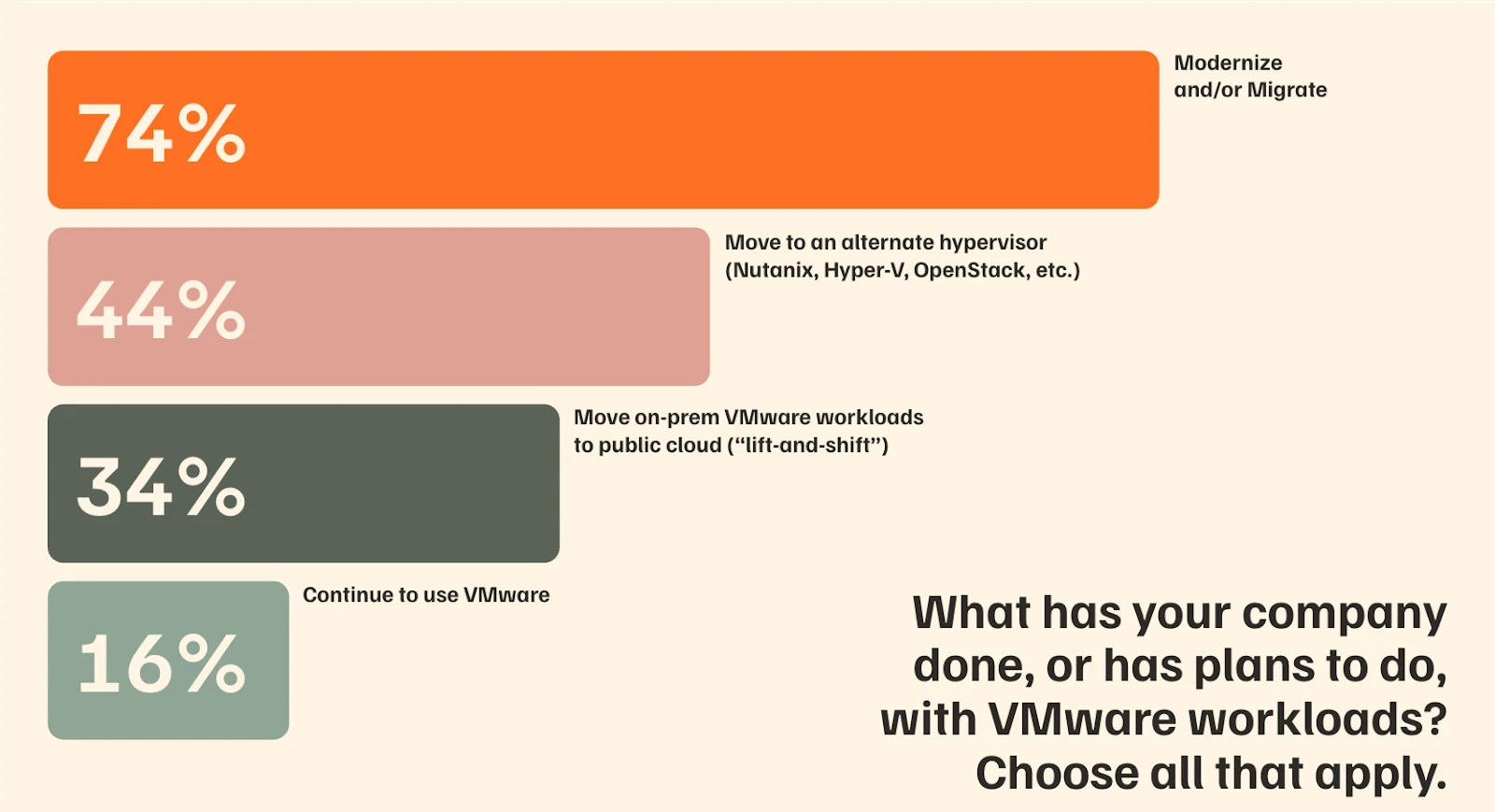
The chart illustrates just how broad this reassessment has become. While some organizations are exploring alternative hypervisors, the most common path forward involves modernizing workloads and consolidating them onto Kubernetes.
In fact, 74% of organizations say they plan to modernize or migrate VMware workloads, with many identifying Kubernetes as the long-term platform for those environments. Some organizations are re-architecting applications as containers, taking the opportunity to modernize legacy systems as part of the transition. Others are taking a more incremental path—running virtual machines directly on Kubernetes using technologies such as KubeVirt or OpenShift Virtualization.
Either way, the direction is clear: enterprises are looking to consolidate infrastructure onto fewer, more flexible platforms.
The findings in the Voice of Kubernetes Report 2026 confirm what many platform teams already know: Organizations are breaking down the traditional boundaries between containers and virtual machines, consolidating infrastructure onto Kubernetes, and building platforms capable of supporting the next generation of applications—from AI to global data services.
The winners will not simply be the organizations that migrate fastest. They will be the ones that build platforms capable of delivering performance, resilience, and data mobility at scale.
Download the full Voice of Kubernetes Report 2026 to explore all the findings and see how enterprises are navigating this transition.
Share
Subscribe for Updates
About Us
Portworx is the leader in cloud native storage for containers.
Thanks for subscribing!

Janet Wi
Group Manager, Product MarketingJanet Wi is Group Product Marketing Manager at Portworx by Pure Storage, leading GTM for enterprises seeking cloud-native technology solutions. An avid reader and writer, she has a passion for customer storytelling in technical industries, which has remained central to her work as a product marketer.
Related posts
Bringing Enterprise VM Operations to Kubernetes with Portworx Enterprise 3.6