Technical Insights
AWS us-east-1 Outage: The Data Resilience Wake-Up Call

Summarize Blog With
Table of Content
On October 20, 2025, a major AWS outage struck the us-east-1 region. Following what was widely reported as a DNS issue at the root, retailers, banks, streaming services, and logistics providers all reported downtime or degraded performance. This event, now known as the AWS us-east-1 outage, is another reminder that even the largest cloud provider is not immune to disruption. Businesses that rely entirely on a single platform will eventually face the consequences of that dependency.
What the AWS Outage in us-east-1 Exposed
- Over-reliance on a single provider: Many organizations still run everything on one cloud, often in a single region. When that provider goes down, operations stop. The AWS outage made it clear: uptime is not guaranteed, even in the cloud.
- Data immobility and vendor lock-in: Applications and data often depend on proprietary services that can’t be easily replicated or migrated. When an outage occurs, teams have no practical way to move workloads to another region or provider.
- Weak disaster recovery: Disaster recovery is often treated as a compliance checkbox instead of a real business requirement. A region-wide outage isn’t theoretical – it’s a risk that every enterprise should design for.
What Businesses need – resilience at every level of the application architecture
To build real resilience, companies need to plan for cloud failure as a normal operating scenario, not an edge case.
- Run and own your services and data: Leverage cloud for what it does best: rent you the infrastructure. The smart way to architect applications is to build them over a cloud abstraction layer like Kubernetes, and reduce your reliance on the cloud provider hosted services. This significantly reduces your blast radius when an outage happens as you can now architect applications to be fully resilient with best of the breed stacks.
- Hybrid and multi-cloud deployment: Architect applications and data across both on-premises and multiple cloud environments. This reduces dependency on a single provider or region and keeps critical services online when one fails.
- Data portability: Design for the ability to move data seamlessly between environments. Use technologies that maintain consistent storage formats and policies across clouds.
- Disaster recovery readiness: Automate failover, backup, and restore processes so recovery is fast and predictable. Ensure your recovery targets include cloud platform failures, not just hardware loss or human error.
- Operational visibility and control: Monitor data and applications across environments. Detect failures quickly and enable teams to shift workloads with minimal downtime.
Building Application and Data Redundancy
A resilient architecture starts with two principles: application redundancy and data reliability. Together, they ensure your systems stay available even when a major provider fails.
Application redundancy means running your workloads across clusters, regions, or clouds with automated failover. This prevents a single-region or single-cloud dependency from taking down customer-facing services.
Data reliability means ensuring your stateful data – databases, transactions, persistent volumes – remains consistent and recoverable across environments. Replication, snapshots, and cross-cloud synchronization make recovery possible within minutes, not hours.
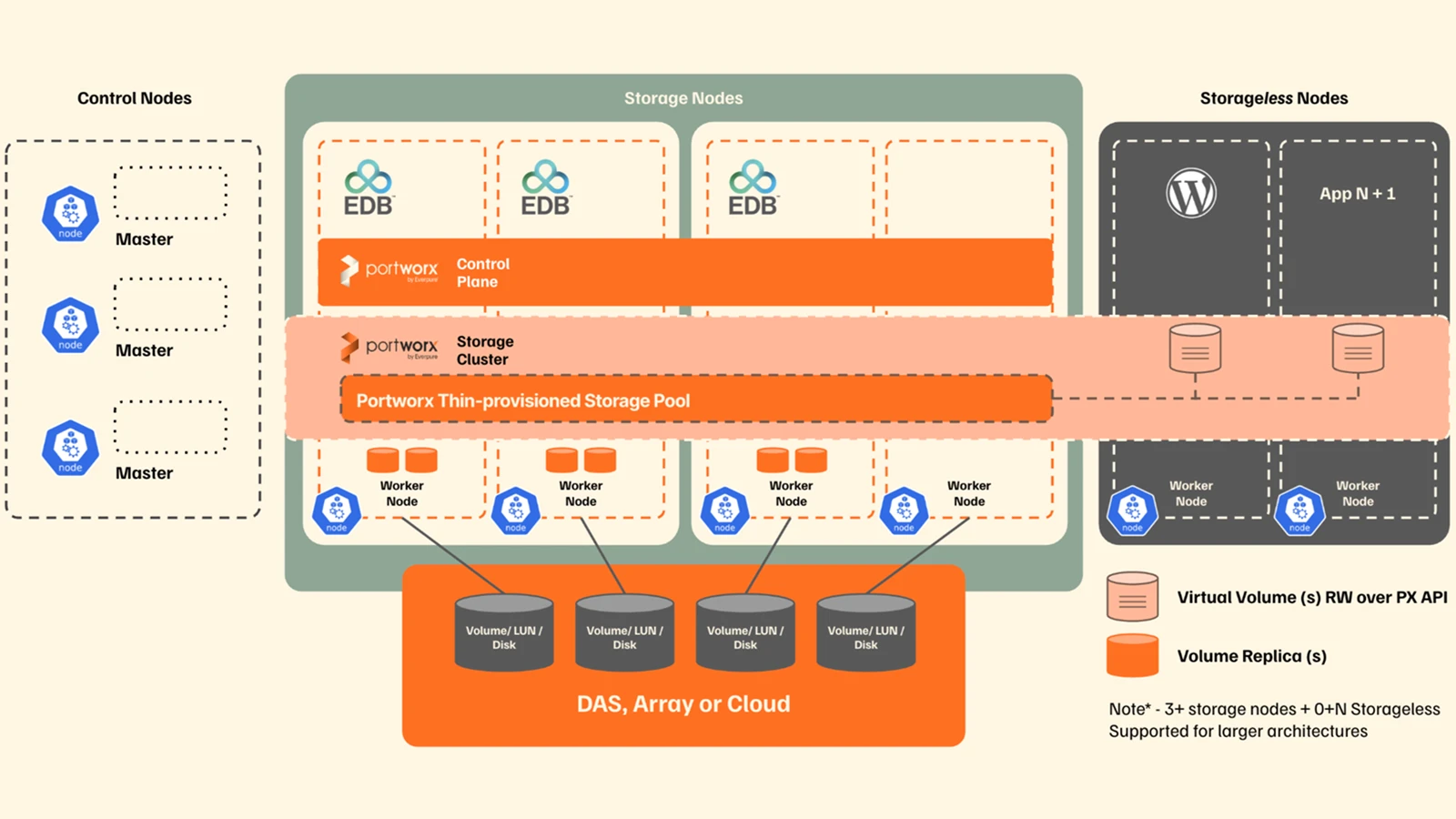
The right data platform should unify these capabilities so that applications and their data can move together, without friction. Solutions like Portworx exemplify this approach, providing consistent data services across any Kubernetes environment – on-prem, in the cloud, or across both. More importantly, Portworx comes with application aware DR that can provide resiliency across a single cloud provider’s regions so outages in one region doesn’t take your entire application down. This type of architecture gives enterprises the control and flexibility they need to weather any outage.
Your Next Move: Designing Resilience Beyond the AWS Outage
The recent AWS outage—whether caused by a widespread DNS issue or another infrastructure failure—is not a one-off event. The failure in us-east-1 is a signal that reliance on a single provider is a critical, systemic vulnerability. The next failure could come from any cloud, any region, at any time. Businesses that continue to treat the cloud as a single point of dependency will keep paying the price in downtime and lost revenue. Enterprises must now design for mobility, recovery, and control across multiple regions and clouds to ensure their business keeps running—no matter who goes down. This is the only way to safeguard your future against the risk highlighted by the aws us-east-1 outage.
To help you move from a wake-up call to a proactive strategy, leverage these expert resources:
- Build a resilient, self-service data platform on Kubernetes. Watch the webinar now.
- Learn about the future of VM workloads on Kubernetes. Download the report.
Recommended for you